Soybean Price Forecast Strengthens as China Buying Supports CBOT Futures
The soybean price forecast has improved considerably from the outlook that dominated the market earlier this summer. In June, CBOT soybeans were struggling near four-month lows while traders relied mostly on speculation that Chinese buyers might return to the U.S. market. By September, that demand story has become more concrete, with confirmed U.S. export sales to China helping soybean futures recover sharply from their mid-August levels.
November 2026 soybean futures have gained roughly $1.50 since mid-August, supported by stronger export demand, concerns about U.S. production potential and robust domestic use. The September USDA balance sheet also tightened projected U.S. ending stocks to 310 million bushels, even as production was raised to nearly 4.54 billion bushels. That combination leaves the market better supported than the original June article suggested, but it does not remove the risk of harvest pressure or large South American supplies. (Farm Progress)
The central question has therefore changed. Traders are no longer asking whether China might return to the U.S. soybean market; they are evaluating whether the current buying pace can remain strong enough to absorb a potentially record U.S. crop and compete with Brazil’s dominant export position.
For broader agricultural and commodity coverage, readers can follow Finprozone’s Futures Updates.
China Demand Has Moved From Rumor to Confirmed Sales
Chinese demand was originally the weakest part of the bullish soybean argument. The June rally was driven largely by market chatter, which meant futures had little fundamental support unless those expectations translated into actual purchases. That situation has now changed.
USDA export announcements confirmed several fresh soybean sales to China during early September. Private exporters reported 136,000 metric tons for China on September 1, followed by 202,000 tons on September 2, 192,000 tons on September 3 and another 272,000 tons on September 10. Those transactions provide a much stronger foundation for the current demand story than the speculative buying expectations that supported the original article. (FAS USDA)
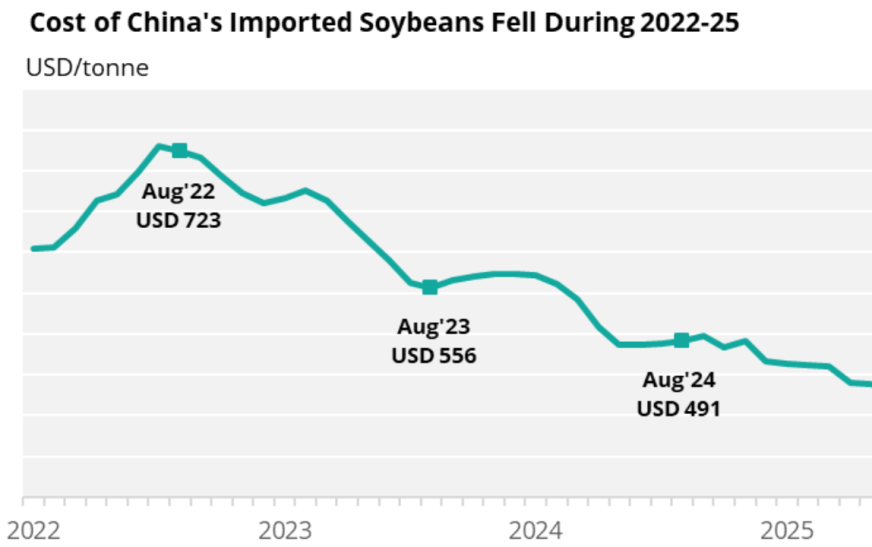
By late August, outstanding U.S. new-crop soybean commitments to China had already reached about 7.76 million metric tons, while total 2026/27 U.S. soybean commitments were approaching 16.3 million tons. That represents a significant improvement from the previous marketing year, when trade tensions sharply reduced U.S. access to its largest traditional soybean customer. (Farm Progress)
China’s return does not guarantee an uninterrupted rally, but it materially changes the balance of risks. Futures now have confirmed export demand supporting them rather than relying exclusively on hopes that lower prices will eventually attract buyers.
USDA’s September Balance Sheet Is Tighter Than the Harvest Size Suggests
The September USDA outlook presents a more complicated supply picture than a simple “large crop equals lower prices” argument.
USDA increased the estimated U.S. soybean yield to 52.8 bushels per acre from 52.7 bushels previously, taking projected production to nearly 4.54 billion bushels. That would leave the United States with a very large harvest and means combines moving through the Midwest can still create seasonal pressure on nearby futures.
However, the demand side of the balance sheet has also strengthened. USDA kept projected domestic crush at 2.78 billion bushels and lifted exports to approximately 1.69 billion bushels. As a result, projected ending stocks fell to 310 million bushels from 320 million in the previous estimate. (Farm Progress)
That 310-million-bushel carryout is important because it prevents the large production number from automatically becoming overwhelmingly bearish. Strong domestic processing and improving exports are absorbing a meaningful portion of supply, leaving the market more sensitive to further changes in demand or production.
The practical implication is that soybean futures may experience harvest-related weakness without returning to the deeply bearish structure seen earlier in the summer. A large crop matters, but available stocks after demand are more relevant than production alone.
Domestic Crush Demand Is Becoming a Bigger Market Driver
China receives much of the attention in soybean coverage, but domestic demand has become increasingly important to the U.S. balance sheet.
USDA currently projects soybean crush at around 2.78 billion bushels for 2026/27. Strong processing demand means more soybeans are being converted domestically into soybean meal and soybean oil rather than relying solely on export markets to clear the crop. (Farm Progress)
That changes the market’s vulnerability to trade flows. A soybean market heavily dependent on exports becomes especially sensitive to changes in Chinese purchasing behavior, tariffs or competition from Brazil. Stronger domestic crush creates another source of demand and can help absorb supply even when exports temporarily slow.
Soybean oil demand also connects the crop to energy and biofuel markets. That relationship means soybean futures are influenced not only by acreage and weather but also by processing margins, vegetable-oil demand and broader energy conditions.
Readers following those cross-market relationships can monitor Finprozone’s Market News alongside agricultural futures.
Harvest Pressure Still Limits the Short-Term Upside
The stronger demand outlook does not mean soybean futures have an unrestricted path higher.
The U.S. harvest is entering the period when physical supplies move rapidly into commercial channels. Farmers delivering newly harvested soybeans can increase cash-market availability, pressure local basis levels and reduce the urgency for buyers to chase futures higher.
November soybean futures recently established support around the $13 area after the September USDA report, while the $13.35 region has acted as nearby resistance. Those levels are more useful as indicators of current market positioning than the $11.07–$11.30 range discussed in the original June article, which is now outdated. (Farm Progress)
The rally from mid-August also means some bullish expectations have already been priced in. Futures gained approximately $1.50 during that period, so continued gains require new information rather than simply repeating the same China-demand story.
A period of consolidation during harvest would therefore not necessarily invalidate the improved soybean outlook. It could instead reflect the market balancing stronger demand against seasonal supply pressure.
For chart-based market context, readers can use Finprozone’s Technical Summary.
Brazil Remains the Largest Supply Risk for the Bullish Case
The biggest challenge to a sustained U.S. soybean rally may come from South America rather than the United States.
USDA’s September outlook places Brazil’s 2026/27 soybean production at approximately 186 million metric tons. Brazil also remains the world’s dominant soybean exporter, with projected exports around 118 million tons. If that crop develops normally, abundant Brazilian supplies could compete aggressively with U.S. soybeans in the global market. (Farm Progress)
Brazil’s crop is particularly important because its marketing cycle overlaps with a period when global buyers, especially China, can shift purchases toward whichever origin offers the strongest combination of price and availability. A large Brazilian harvest would therefore limit how much U.S. futures can benefit from strong Chinese demand.
At the same time, South American production is not guaranteed. Weather during planting and crop development will become increasingly important through the coming months. Any meaningful deterioration in Brazilian yield expectations would tighten the global balance sheet and increase the importance of U.S. supplies.
The soybean price forecast therefore cannot be built around U.S. production alone. Brazil’s crop development is likely to become one of the dominant variables heading into 2027.
Global Stocks Remain Comfortable, but the Cushion Is Narrowing
The global soybean market is not facing an outright shortage.
USDA currently projects 2026/27 global ending stocks at about 124.02 million metric tons. That remains a comfortable absolute inventory level and provides an important counterweight to bullish arguments based on U.S. stocks or Chinese purchases. (Farm Progress)
However, absolute stocks do not tell the entire story. Consumption continues to grow, which means traders also need to consider inventories relative to demand. A large stock figure can become less comfortable if global usage expands faster than available supply.
This distinction matters because soybean futures are entering a period where relatively small changes in South American production, Chinese imports or U.S. exports can meaningfully change the outlook even without creating a true global shortage.
The current environment is therefore better described as adequately supplied but increasingly demand-sensitive.
U.S.-China Trade Developments Remain an Important Catalyst
Agricultural trade remains a major part of the U.S.-China economic relationship, with soybeans among the most important products involved. China has resumed substantial U.S. soybean purchases, and additional trade discussions could influence the pace of future buying. (Reuters)
For soybean traders, official purchase data matters more than political statements or market rumors. The market learned that lesson earlier this year when expectations of Chinese demand generated short-term rallies before confirmed sales became visible.
That makes USDA export announcements and weekly sales data especially important. A continued stream of confirmed Chinese purchases would reinforce the current demand outlook, while a slowdown could expose futures to harvest pressure and South American competition.
The distinction between commitments and actual shipments also deserves attention. Large forward sales are constructive, but sustained demand ultimately needs to appear in export execution as the marketing year progresses.
Upcoming USDA reports and major economic events can be tracked through Finprozone’s Economic Calendar.
Soybean Price Forecast: Demand Is Stronger, but Supply Still Matters
The soybean price forecast has moved from the defensive position seen in June toward a more balanced-to-constructive outlook.
China’s return to the U.S. market is now supported by confirmed export sales rather than speculation. Domestic crush demand remains strong, USDA has reduced projected U.S. ending stocks to 310 million bushels, and November futures have recovered sharply from their August lows. Those developments give soybean prices a stronger fundamental foundation than they had earlier in the summer.
The limiting factor is supply. USDA still expects nearly 4.54 billion bushels of U.S. production, harvest pressure is increasing, Brazil could produce around 186 million metric tons, and global ending stocks remain above 124 million tons. Those numbers mean the market still needs continued demand or a supply disruption to sustain a larger advance.
Near term, the $13 area has become an important reference for November futures, while the region around $13.35 has recently limited gains. Rather than treating those prices as guaranteed targets, traders should use them alongside export sales, harvest progress, South American weather and updated USDA balances.
The next phase of the soybean market will depend less on whether China is interested and more on whether Chinese purchases continue at a pace strong enough to offset large U.S. and Brazilian supplies.
For continuing commodity analysis, readers can follow Finprozone Pro.
FAQ
Why have soybean futures strengthened since August?
Soybean futures have gained support from stronger domestic demand, concerns about U.S. production and a clear return of Chinese buying. November 2026 futures have risen roughly $1.50 since mid-August, changing the market structure from the weakness seen earlier in the summer.
Is China actually buying U.S. soybeans again?
Yes. USDA confirmed several significant soybean sales to China during late August and early September. That makes the current demand story materially stronger than the June market, when much of the bullish narrative depended on unconfirmed buying expectations.
What does USDA currently expect for the U.S. soybean crop?
The September outlook placed yield near 52.8 bushels per acre and production at approximately 4.54 billion bushels. Despite the large harvest, stronger demand reduced projected ending stocks to about 310 million bushels.
Why are U.S. ending stocks important?
Ending stocks represent the supply expected to remain after projected domestic consumption and exports. A lower carryout means the market has less excess inventory available to absorb unexpected demand growth or production problems.
How important is Brazil to the soybean forecast?
Brazil is critical because it is the world’s largest soybean producer and exporter. A crop near current expectations would provide substantial global supply, while a significant weather-related shortfall could tighten the market and strengthen U.S. futures.
What should soybean traders monitor next?
The most important variables are confirmed Chinese export sales, U.S. harvest results, USDA stock estimates, domestic crush demand, Brazilian weather and South American production expectations. These factors will determine whether the recent rally develops into a broader trend or settles into a harvest-period trading range.