The dollar forecast strengthened again after the U.S. Dollar Index extended gains for a fifth consecutive session, supported by growing expectations that the Federal Reserve may keep interest rates elevated through the rest of the year. The move showed that traders are still prioritizing U.S. rate differentials, even as some domestic economic data weakened and lower crude oil prices reduced part of the inflation pressure.
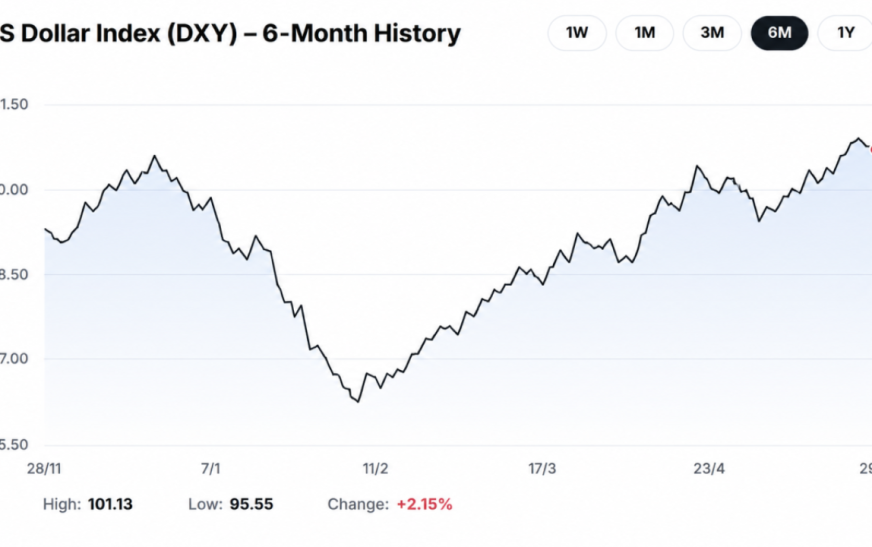
According to the original dpa-AFX report published through TradingView, the U.S. Dollar Index was last seen trading at 101.58, up 0.19% on the day. The dollar gained against major currencies including the euro, pound, yen, Swiss franc, Canadian dollar, and Australian dollar as traders continued adjusting to the Federal Reserve’s latest projections.
The central driver remains the Fed’s hawkish signal. Last week, the Federal Open Market Committee kept rates in the 3.50% to 3.75% range, citing inflationary pressures. Its Summary of Economic Projections suggested a more restrictive policy outlook, with nine Fed officials projecting a rate hike in 2026, eight expecting no change, and only one anticipating a rate cut.
Dollar Extends Gains as Rate-Cut Bets Fade
The dollar’s fifth straight daily gain shows that the market has moved further away from expecting a near-term easing cycle. Traders have reduced expectations for any possible Fed rate cut in 2026, while the possibility of another hike has returned to the center of the discussion.
This shift is important because the dollar often strengthens when U.S. interest-rate expectations rise relative to other major economies. Higher rates can support the greenback by increasing the yield available on dollar-denominated assets. If investors believe U.S. rates will remain high while other central banks become more cautious, the dollar can attract more capital.
The latest Fed projections reinforced that view. Inflation is still expected to remain elevated, and policymakers are divided between another hike and holding rates steady. That is not a dovish setup. Even if the Fed does not raise rates immediately, the absence of a clear rate-cut path gives the dollar support.
The dollar has gained nearly 3.50% since the beginning of the year, according to the dpa-AFX report. That performance shows that rate expectations have become a durable support rather than a short-term reaction.
DXY Rises to 101.58
The U.S. Dollar Index rose to 101.58, marking another advance in a strong multi-session run. DXY measures the greenback against a basket of major currencies, so a move higher indicates broad dollar strength rather than isolated weakness in one pair.
The latest increase was moderate at 0.19%, but the direction matters. A fifth consecutive daily gain suggests that traders are still adding or maintaining dollar exposure after last week’s Fed update.
For technical traders, the 101.58 level may become an important reference point. If DXY continues holding above 101, bullish momentum may remain intact. A move toward higher resistance levels would suggest that the market is still repricing the Fed path. A reversal below recent support could indicate that the dollar rally is becoming overextended.
The current setup is not based only on safe-haven demand. The dollar is rising because the interest-rate outlook remains supportive. That makes the next inflation, jobs, and Fed communication signals especially important.
FedWatch Shows July Hike Risk
CME Group’s FedWatch Tool showed investors pricing a 34.20% chance of a quarter-point interest rate hike at the July 28-29 Federal Reserve meeting, while the probability of rates being held at current levels stood at 65.80%.
This means markets still see a hold as the most likely outcome, but the probability of a hike is significant enough to support the dollar. A one-in-three chance of a near-term hike is not a minor pricing detail. It tells traders that the Fed’s hawkish projections are being taken seriously.
The July meeting now becomes a key event for the dollar forecast. If inflation or labor-market data strengthens before then, rate-hike expectations could increase further. That would likely support DXY. If data weakens sharply, the market may reduce hike expectations and take profit on dollar longs.
The Fed’s challenge is balancing inflation concerns against signs of softness in some economic areas. Housing data weakened, mortgage purchase activity slipped, and the current account deficit widened. Yet the dollar still gained because rate expectations remained the dominant driver.
Weak Housing Data Fails to Stop Dollar Strength
The dollar rose even though U.S. housing data disappointed. The Mortgage Bankers Association reported that the Purchase Index declined to 169.70 on June 19 from 170.80 the previous week. The U.S. Census Bureau also reported that new single-family home sales fell 7.30% month-over-month to a seasonally adjusted annualized rate of 580,000 in May, the lowest in four months.
Normally, weaker housing data can pressure the dollar because it suggests that higher interest rates are weighing on the economy. Housing is one of the most rate-sensitive sectors, so falling new home sales can point to softer demand, affordability stress, or buyer caution.
However, the market did not treat the data as enough to change the Fed outlook. That is the key point. The dollar can continue rising despite weak sector-level data if traders believe inflation remains the bigger problem.
For now, the Fed’s high-rate message is stronger than the housing slowdown signal. But if housing weakness spreads into employment, consumer spending, or broader growth indicators, the dollar rally could face a more serious test.
For broader coverage of economic indicators, Fed policy, and currency-market reactions, readers can follow Finprozone latest market news as incoming data shapes the next stage of the dollar trend.
Current Account Deficit Widens
The U.S. current account deficit widened to a seasonally adjusted $226.8 billion in the first quarter of 2026, up from a revised $221.1 billion in the fourth quarter of 2025, according to the U.S. Bureau of Economic Analysis data cited by dpa-AFX.
The widening deficit contrasts with the administration’s goal of narrowing trade and external balances through tariffs and higher energy exports. From a currency perspective, a larger current account deficit can sometimes be a negative factor because it reflects more money flowing abroad through trade and income balances.
However, the dollar’s reaction shows that interest-rate expectations are currently more important than external-balance concerns. Investors are still willing to hold dollars because U.S. yields and policy expectations remain attractive.
That does not mean the current account data is irrelevant. Over time, persistent external deficits can become part of the broader macro debate. But in the short run, the Fed remains the main driver of DXY.
Dollar Gains Against Euro and Pound
The dollar advanced against both the euro and the pound. The report showed the dollar trading at 1.136 against the euro, up 0.20%, and 1.317 against the British pound, up 0.28%.
These moves reflect a continuation of dollar strength across major European currency pairs. If the Fed remains hawkish while other central banks are seen as less aggressive, EUR/USD and GBP/USD can remain under pressure.
The euro and pound are both sensitive to relative rate expectations. Even when Europe or the UK faces inflation pressure, traders compare the expected policy path with the U.S. outlook. If the Fed is seen as more likely to keep rates higher or raise again, the dollar retains an advantage.
For the pound, this follows recent pressure after the Bank of England held rates. For the euro, the issue is whether European policy expectations can keep pace with the U.S. dollar’s yield support.
Yen Weakens Further Against the Dollar
The Japanese yen traded at 161.814 against the U.S. dollar, down 0.15%. Yen weakness remains one of the most closely watched parts of the foreign-exchange market because USD/JPY is near levels that can raise intervention concerns.
The yen is vulnerable when U.S. rate expectations rise. Higher U.S. yields make the dollar more attractive, while the yen often struggles when Japan’s interest-rate structure remains comparatively low.
If USD/JPY continues rising, traders may become more alert to verbal warnings or direct action from Japanese officials. Currency intervention risk can create sharp short-term moves, even if the broader rate differential continues to favor the dollar.
For the dollar forecast, yen weakness reinforces the broader theme: high U.S. rates remain a powerful support. But intervention risk can make USD/JPY more volatile than other dollar pairs.
Australian Dollar Pressured by Softer CPI
The U.S. dollar also strengthened against the Australian dollar. The report showed the U.S. dollar trading at 0.690 against one Australian dollar, up 0.23%.
Australian inflation data added pressure. The Consumer Price Index in Australia fell 0.70% month-over-month in May, marking its first decline since August. Annual inflation slowed unexpectedly to 4.00% from 4.20% in April, below expectations of 4.40%, although still above the central bank’s 2.00% to 3.00% target range.
This matters because softer inflation can reduce pressure on the Reserve Bank of Australia to tighten further. If Australian rate expectations cool while U.S. rate expectations remain firm, AUD/USD can weaken.
The Australian dollar is also sensitive to global risk appetite and commodity trends. Lower crude prices and a stronger dollar can add to pressure if investors rotate away from commodity-linked currencies.
Lower Oil Prices Create a Complicated Dollar Signal
The reopening of the Strait of Hormuz after a U.S.-Iran memorandum of understanding has helped drive crude oil prices lower. Trump also confirmed that Iran agreed to keep the strait open with no toll or fee collection for ships passing through.
Lower oil prices can reduce inflation pressure, which might normally weaken the case for higher Fed rates. But the dollar still advanced because markets remain focused on the Fed’s projections and the broader high-rate regime.
This creates a more complicated dollar signal. On one side, lower oil can ease inflation and eventually reduce the need for restrictive policy. On the other side, lower oil can support growth by reducing costs for consumers and businesses. If growth remains resilient while inflation stays above target, the Fed may still avoid cutting rates.
For now, traders are not treating lower oil as enough to reverse dollar strength. They want clearer evidence that inflation will fall sustainably before reducing high-rate expectations.
What Traders Should Watch Next
The first signal is DXY near 101.58. Holding this level would confirm that the dollar rally remains intact, while a reversal could suggest short-term exhaustion.
The second signal is the July 28-29 Fed meeting. Markets currently price a 34.20% chance of a quarter-point hike, making the meeting an important dollar catalyst.
The third signal is inflation data. If inflation stays elevated, the dollar may remain supported. Softer inflation would challenge the high-rate thesis.
The fourth signal is housing and consumer data. Weak new home sales matter, but traders need broader evidence of economic slowdown before changing the Fed outlook.
The fifth signal is USD/JPY. Further yen weakness could raise intervention risk and create volatility in dollar pairs.
FAQ
Why did the U.S. dollar rise again?
The U.S. dollar rose because traders increased bets that the Federal Reserve may keep interest rates high through 2026. The Fed’s latest projections showed a hawkish tilt, with nine officials expecting a rate hike this year and eight expecting no change.
What happened to the U.S. Dollar Index?
The U.S. Dollar Index rose to 101.58, up 0.19% on the day. It marked the fifth consecutive session of gains as the dollar strengthened against the euro, pound, yen, Swiss franc, Canadian dollar, and Australian dollar.
Could the Fed raise rates in July?
Markets see a July rate hike as possible but not the base case. CME FedWatch data cited in the report showed a 34.20% chance of a quarter-point hike at the July 28-29 meeting, while the probability of no change stood at 65.80%.
What could weaken the dollar forecast?
The dollar forecast could weaken if inflation falls faster than expected, U.S. housing and consumer data deteriorate, Fed officials soften their tone, or traders reduce July rate-hike expectations. A pullback in DXY below key support levels could also signal fading momentum.