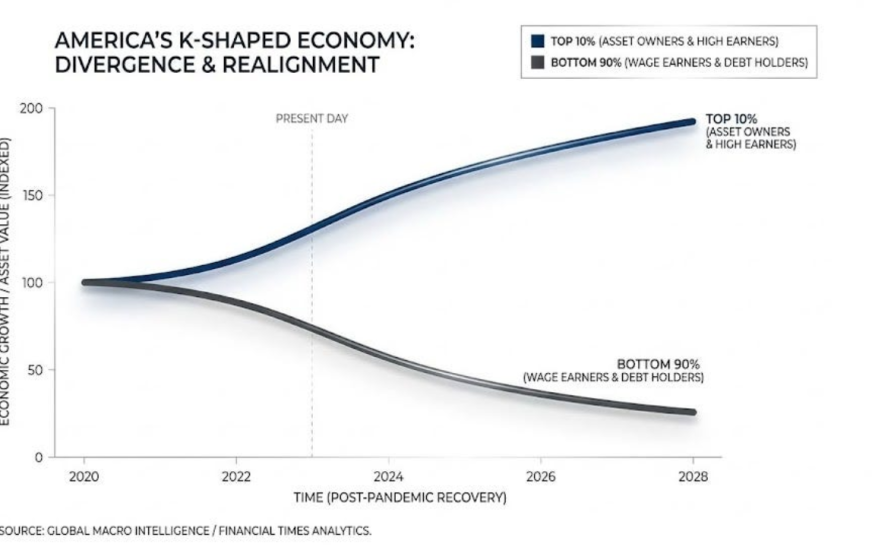
Inflation pressure is forcing American households into a sharper divide, with lower- and middle-income consumers cutting back while affluent shoppers continue spending on premium goods and services. The latest Federal Reserve Beige Book shows that higher energy costs linked to the war with Iran are spreading through the economy, lifting grocery prices, shipping costs, packaging expenses, fertilizer prices, and other everyday bills.
According to the original MarketWatch report published through TradingView, the Fed’s latest survey found that inflation surged across the U.S. economy in late April and May, pushing many families into a new phase of reduced spending power. The report also showed that affordability pressures are widening the gap between income groups, reinforcing the idea of a K-shaped economy.
This matters because inflation is no longer limited to gasoline or energy bills. When higher energy costs feed into food, transportation, repairs, electronics, and business expenses, the pressure becomes harder for households and firms to absorb. For the Federal Reserve, the timing is especially important. The central bank meets on June 16-17 to discuss interest-rate policy, and the latest Beige Book gives policymakers another warning that inflation may be becoming more persistent.
Energy Costs Are Spreading Through the Economy
The Beige Book highlighted one of the most difficult features of the current inflation environment: energy costs are not staying contained. Higher fuel prices are flowing into grocery-store prices, shipping, packaging, and fertilizer. That creates a broader cost shock because energy is embedded in many parts of the supply chain.
For households, the effect is direct and indirect. Gasoline, electricity, heating, and transport costs hit budgets immediately. But the second-round effects can be just as damaging. If shipping costs rise, stores may pay more to move goods. If packaging costs rise, food and consumer-products companies face higher production expenses. If fertilizer prices climb, agricultural costs can pressure food prices over time.
This is why inflation pressure can feel larger than official headline categories suggest. Consumers may not track the specific source of each price increase, but they feel the combined effect when groceries, car repairs, electronics, and daily services become more expensive.
For businesses, the challenge is also serious. Companies must decide whether to raise prices, absorb costs, reduce offerings, adjust supply chains, or change product mixes. Each option carries risk. Raising prices can protect margins but weaken demand. Absorbing costs can preserve customer relationships but reduce profitability. Cutting offerings can improve efficiency but may damage growth.
The K-Shaped Economy Becomes More Visible
The Fed’s survey showed a clear divide between consumers by income level. Low-income consumers showed the greatest financial strain, while middle-income households became more cautious. Higher-income households remained more resilient because they are less sensitive to price increases.
The Kansas City region offered one of the clearest descriptions of the middle-income consumer: households were “squeezing more life out of every dollar before deciding to spend it.” That phrase captures a practical shift in spending behavior. Families are not necessarily stopping all purchases, but they are delaying decisions, comparing prices more carefully, prioritizing necessities, and using credit cards to manage pressure.
At the same time, higher-end spending remains strong. One large shopping mall in New York state reported that luxury-focused tenants were seeing strong demand, especially for accessories such as wristwatches, while midtier and lower-end retail tenants experienced more subdued sales. In Atlanta, one business contact described higher-end consumer demand as focused on “unapologetic luxury.”
This contrast is the core of the K-shaped economy. One side continues to spend, invest, and absorb inflation. The other side cuts back, borrows more, and becomes increasingly vulnerable to cost shocks. For investors, this divide matters because companies exposed to affluent customers may report stronger demand than companies serving lower- and middle-income shoppers.
Consumer Spending Is Becoming More Defensive
The Beige Book showed that many Americans are adjusting to inflation by using credit cards, reducing retail visits, and focusing on necessities. This behavior suggests a more defensive consumer environment, especially outside the higher-income segment.
Reduced retail visits matter because they can affect store traffic, discretionary sales, and impulse purchases. When consumers shop less often, businesses may need to compete harder on price, promotion, or convenience. A greater focus on necessities also shifts demand away from discretionary categories, which can hurt retailers, restaurants, entertainment businesses, and service providers that rely on flexible household spending.
Credit-card use is another important signal. When consumers rely more heavily on credit to maintain spending, short-term sales may hold up, but financial stress can build. If wages do not keep pace with expenses, credit balances may rise, delinquencies may increase, and future spending power may weaken.
This is why inflation pressure can damage growth even when headline spending does not immediately collapse. Households may continue spending for a while, but the quality of that spending changes. More money goes toward essentials and debt management, while less goes toward discretionary consumption and savings.
For market readers tracking inflation, consumer spending, and Fed policy, Finprozone latest market news provides continued coverage of economic indicators that influence stocks, bonds, commodities, and currencies.
Businesses Are Fighting to Protect Margins
The Fed report showed that businesses are worried about profit margins as costs rise. Many firms are debating whether to pass higher costs to consumers or absorb them to protect demand. This is one of the most important corporate themes in an inflationary economy.
Several Fed districts reported inflation-mitigation strategies, including supply-chain adjustments, reduced offerings, and absorbing higher costs. These actions show that businesses are actively managing the shock rather than simply raising prices across the board.
In the Northeast, many contacts did not plan to raise output prices in the near term, even though they were concerned that cost pressures tied to the Middle East conflict could persist. This suggests that some businesses are cautious about customer resistance. If consumers are already stretched, higher prices may reduce sales volumes.
Philadelphia showed a different pattern. Consumer-facing businesses held prices steady, but manufacturers raised prices by more than 4%, the strongest pace in two and a half years. That split is important. It suggests price pressure may be building upstream even when retailers are hesitant to pass costs to consumers immediately.
If manufacturers keep raising prices while retailers resist, margins can be squeezed somewhere in the chain. Either producers absorb costs, retailers accept weaker margins, or consumers eventually face higher prices. None of those outcomes is painless.
Wage Growth Adds Another Inflation Risk
Wage growth stayed modest to moderate, but the Beige Book reported more frequent wage adjustments and cost-of-living increases to help workers manage higher fuel and household expenses. This is a key development because wage adjustments can make an inflation shock more persistent.
When wages rise to offset higher living costs, households may gain some relief. But businesses facing higher wages may then raise prices to protect margins. This can create a feedback loop where higher prices lead to higher wage demands, and higher wages then contribute to further price increases.
Sal Guatieri, senior economist at BMO Capital Markets, warned that these wage increases could turn the oil-price shock into a persistent general rise in inflation. That is exactly the kind of risk the Federal Reserve watches closely.
The Fed can look through temporary energy spikes if officials believe they will fade quickly. But if energy-driven inflation feeds into wages, consumer expectations, and broader prices, the central bank may treat it as a more serious threat. That could influence the tone of the June meeting and the path of interest rates.
The Fed Faces a Difficult Policy Setup
The Federal Reserve is entering its June 16-17 meeting with a complicated economic backdrop. Growth remains positive but subdued. Consumer spending is uneven. Businesses are uncertain. Inflation pressure is spreading. Wage adjustments are becoming more frequent. Lower-income households are under visible strain.
This is not an easy environment for monetary policy. If the Fed keeps policy tight to fight inflation, it may add pressure to consumers, small businesses, and interest-rate-sensitive sectors. If it eases too soon, inflation expectations could become harder to control.
The report quoted Heather Long, chief economist at Navy Federal Credit Union, describing the Beige Book as another warning sign that inflation is becoming sticky. She also said the economy currently has an inflation problem. That view reflects the central challenge for policymakers: even if parts of the economy are slowing, price pressures remain too important to ignore.
The source also noted that the new Fed chair, Kevin Warsh, and his colleagues will need to reassure markets, especially bond investors, that inflation will be brought back down. Bond investors are critical because inflation expectations influence yields, borrowing costs, stock valuations, and the dollar.
Why Bond Investors Matter Now
Bond investors watch inflation closely because persistent inflation erodes the value of fixed-income returns. If investors believe inflation will remain elevated, they may demand higher yields. Higher yields can raise borrowing costs for households, businesses, and the government.
That creates a direct link between household inflation pressure and financial markets. If energy costs push inflation expectations higher, Treasury yields may rise. If yields rise, mortgage rates, business loans, and credit costs can stay elevated. That can further pressure consumers and slow investment.
For equity markets, higher yields can weigh on valuations, especially for growth stocks whose future earnings are discounted more heavily when rates rise. For defensive sectors, sticky inflation can also create challenges if input costs rise faster than regulated or market-based pricing.
The Fed therefore needs to manage both real economic conditions and market expectations. A weak message on inflation could unsettle bond markets. An overly restrictive message could increase concerns about growth. The Beige Book gives the Fed evidence that inflation pressure is still active, but it also shows that households and businesses are not all absorbing it equally.
Investment Implications Across Sectors
The widening K-shaped economy has direct implications for investors. Luxury retailers, premium service providers, and companies serving higher-income consumers may remain more resilient. Businesses exposed to lower- and middle-income customers may face weaker traffic, more price sensitivity, and higher credit risk.
Consumer staples may benefit from necessity-based spending, but even staple companies can face margin pressure if input costs rise faster than pricing. Discretionary retailers may struggle if consumers reduce visits and delay purchases. Banks and lenders may need to monitor credit-card balances and consumer stress more closely.
Manufacturers face a different challenge. If input costs continue rising, they may need to raise prices, accept lower margins, or improve efficiency. Companies with strong pricing power may manage the environment better than those competing mainly on price.
For commodities, the link between energy and inflation remains central. Any easing in the Iran conflict or energy prices could reduce some pressure. Further escalation could make the inflation problem worse.
FAQ
What does inflation pressure mean for American families?
Inflation pressure means families must spend more on essentials such as energy, groceries, transportation, repairs, and household goods. Lower- and middle-income households are affected most because essentials take up a larger share of their income, forcing many to reduce discretionary spending or rely more on credit cards.
Why is the economy being described as K-shaped?
The economy is being described as K-shaped because higher-income consumers remain resilient and continue spending on premium goods, while lower- and middle-income households face greater financial strain. The Beige Book showed strong luxury demand alongside weaker spending among more price-sensitive consumers.
How could inflation affect the Federal Reserve’s next decision?
Persistent inflation could make the Fed more cautious about easing policy. If energy costs continue spreading into wages, groceries, shipping, and business prices, officials may signal a tougher stance. Investors can track key releases through the economic calendar for upcoming market events before the June 16-17 meeting.
What should investors watch after this Beige Book report?
Investors should watch energy prices, wage growth, consumer spending, credit-card stress, bond yields, and business margin commentary. These signals will help show whether inflation remains manageable or becomes more persistent, which could affect Fed policy, equity valuations, and sector performance.