The dollar forecast strengthened after the U.S. Dollar Index advanced on renewed concerns that Gulf oil production and supply may take longer to normalize, even if the expected U.S.-Iran peace deal holds. Stronger-than-expected U.S. economic data also supported the greenback, while the Federal Reserve’s first meeting under new Chair Kevin Warsh reinforced that inflation remains a central policy concern.
According to the original dpa-AFX report published through TradingView, the U.S. Dollar Index was last seen at 100.39, up 0.84% on the day. The dollar gained broadly against major currencies, rising against the euro, pound, yen, Swiss franc, Canadian dollar, and Australian dollar as traders reassessed energy risks, U.S. growth strength, and the Fed’s policy outlook.
The move shows that the dollar remains sensitive to the full chain connecting geopolitics, oil supply, inflation expectations, and interest-rate policy. Earlier optimism around a U.S.-Iran deal had pressured the greenback by lowering oil prices and reducing rate-hike expectations. But concerns over delayed energy normalization, insurance risks, sea mines, damaged infrastructure, and the possibility of renewed U.S. action against Iran helped restore demand for the dollar.
Dollar Rises as Energy Risks Return
The dollar’s advance was driven partly by concern that oil supply disruptions in the Gulf may not be resolved quickly. Even though U.S. President Donald Trump confirmed that the Strait of Hormuz would reopen once the U.S.-Iran deal is signed on Friday, energy experts warned that normal oil output and supply may take longer to restore.
This distinction is important. A reopened shipping route does not automatically mean immediate normalization. Ship owners may still worry about sea mines, security risks, and elevated insurance premiums. Oil facilities damaged by conflict may require time and major reconstruction spending before they return to full capacity.
For currency markets, those risks matter because delayed oil recovery can keep inflation pressure elevated. If energy supply remains constrained, crude prices may stay supported, and that can feed into consumer prices, producer costs, transport expenses, and broader inflation expectations.
The dollar benefited because traders saw renewed support for the idea that U.S. interest rates may need to remain restrictive. When inflation risks rise, the dollar can gain if investors believe the Federal Reserve will maintain higher rates for longer or consider additional tightening later.
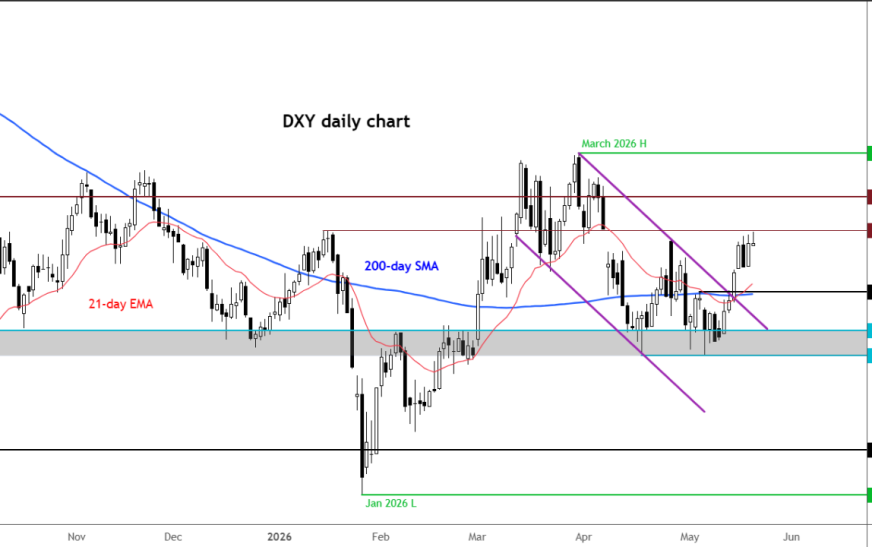
DXY Climbs Above 100
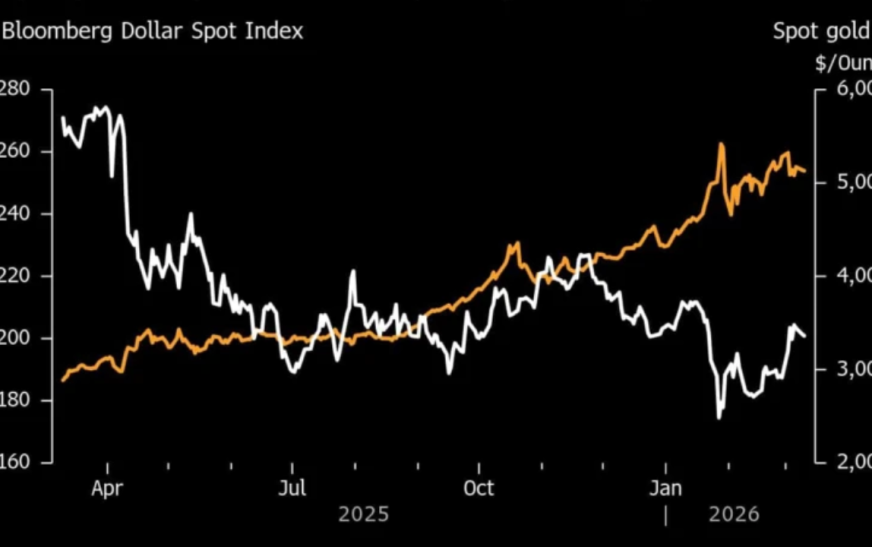
The U.S. Dollar Index climbed to 100.39, up 0.84%, showing broad-based strength across major currency pairs. The dollar rose 0.92% against the euro, with EUR/USD at 1.150, and gained 0.97% against the pound, with GBP/USD at 1.329.
The dollar also strengthened against safe-haven currencies. The Japanese yen traded at 160.686 per dollar, down 0.19% against the greenback, while the Swiss franc weakened 0.82% to 0.799. The Canadian dollar traded at 1.410, down 0.76% against the U.S. currency, and the Australian dollar fell, with the U.S. dollar up 0.75% against one unit of Australian currency.
This broad move suggests the rally was not limited to one regional story. The dollar was supported by multiple forces: energy uncertainty, strong U.S. economic data, Fed inflation concerns, and renewed caution around the U.S.-Iran deal.
The dollar forecast now depends on whether DXY can hold above the 100 level. A sustained move above that area may indicate that traders are rebuilding bullish dollar exposure. A quick reversal would suggest that the rally was mainly a short-term reaction to energy headlines.
Trump Warning Adds Geopolitical Uncertainty
The source report noted that Trump warned he may reorder bombing Iran if the deal fails to meet his expectations. He also emphasized that the Memorandum of Understanding is not final. That warning reduced confidence that the peace process has fully removed geopolitical risk.
For traders, this is a key reason the dollar regained support. Markets had previously reacted positively to the prospect of a U.S.-Iran agreement and the reopening of the Strait of Hormuz. But if the deal remains conditional, fragile, or incomplete, investors may keep some defensive positioning.
The dollar often benefits during geopolitical uncertainty because it remains the world’s primary reserve currency and a major safe-haven asset. When investors are unsure whether a conflict is truly ending, they may prefer dollar liquidity until the outcome becomes clearer.
This does not mean the dollar will rise on every Gulf headline. If the deal is signed smoothly and oil flows normalize faster than expected, the greenback could lose some defensive support. But Trump’s warning means traders cannot assume de-escalation is permanent.
Oil Supply Recovery May Be Slower Than Expected
Energy experts cited in the report raised doubts about a quick restoration of oil supply even if the Strait of Hormuz reopens next week. Ship owners remain concerned about sea mines and higher insurance premiums, while damaged oil facilities may require long and expensive reconstruction.
The Paris-based International Energy Agency also warned that oil inventories could reach historic lows in coming months despite hopes of a U.S.-Iran peace agreement. That detail is important because low inventories can keep oil markets tight even if immediate military escalation eases.
For the dollar forecast, a delayed oil recovery supports the inflation-risk argument. If inventories fall and supply remains constrained, energy prices may stay elevated. That can make it harder for central banks to declare victory over inflation.
The dollar may benefit from this environment because the Fed could remain cautious. If energy prices keep inflation high while U.S. economic data stays strong, markets may continue pricing a restrictive policy path.
For broader coverage of macro data, commodities, central banks, and currency reactions, readers can follow Finprozone latest market news as oil and inflation risks continue shaping global markets.
Strong Retail Sales Support the Greenback
U.S. retail sales also strengthened the dollar. The Census Bureau reported that month-on-month retail sales rose 0.90% in May, above the downwardly revised 0.40% increase in April and stronger than forecasts of 0.50%. Year-over-year, retail sales rose 6.90%, accelerating sharply from April’s 4.80% increase.
This data matters because consumer spending is a major part of the U.S. economy. Strong retail sales suggest that households remain resilient despite inflation, high borrowing costs, and geopolitical uncertainty. For currency traders, that supports the dollar because stronger growth can reduce expectations for rate cuts and keep the Fed focused on inflation.
The May retail sales report also complicates the policy outlook. If demand remains strong, price pressures may be harder to cool. That can make the Fed less willing to ease financial conditions or signal a dovish shift.
For the dollar, this is constructive. A stronger consumer supports the idea that the U.S. economy can handle restrictive rates. It also gives the greenback a growth advantage relative to currencies tied to weaker economies or more cautious central banks.
Pending Home Sales Add to Growth Signal
Housing data also supported the dollar. Pending home sales surged 3.80% month-on-month in May, following a downwardly revised 0.30% rise in April and beating market expectations of 0.80%. On a year-on-year basis, pending home sales increased 4.80%.
Housing is important because it is highly sensitive to interest rates. When pending sales rise despite elevated borrowing costs, it suggests that underlying demand may be stronger than expected. That can reinforce confidence in the broader economy.
For the Fed, stronger housing activity may be a mixed signal. On one hand, it suggests economic resilience. On the other, it may keep inflation risks alive through housing-related demand and price pressures.
For the dollar forecast, the housing data adds another layer of support. Stronger-than-expected retail sales and pending home sales together make it harder for traders to build a bearish dollar case based on economic slowdown.
Fed Holds Rates but Keeps Inflation in Focus
The Federal Reserve left benchmark interest rates unchanged at 3.50% to 3.75%, in line with economist expectations. The decision came at the first meeting under new Fed Chair Kevin Warsh, who replaced Jerome Powell.
The hold itself was expected, but the details were important. The Fed cited resurgent inflation, and nearly half of FOMC members supported an interest rate hike later this year in the Summary of Economic Projections. That kept the policy outlook tilted toward caution rather than easing.
For the dollar, this matters because a hold is not necessarily dovish. If the Fed holds rates while warning about inflation and leaving the door open to another hike, the dollar can remain supported. Investors may interpret the decision as a pause in tightening, not the start of a loosening cycle.
Warsh also said the Fed is exploring new ways to collect economic data, including private-sector indicators. He emphasized that markets should focus on real-economy developments rather than excessively concentrating on central-bank guidance. That message could make future data releases even more important for currency markets.
Warsh’s First Meeting Changes the Communication Dynamic
The first Fed meeting under Kevin Warsh introduced a new communication tone. Warsh’s emphasis on real-economy developments suggests that the central bank may want markets to rely less on forward guidance and more on incoming evidence.
This could increase volatility in the dollar. If traders receive less explicit guidance from the Fed, they may react more sharply to retail sales, inflation, jobs data, housing data, private-sector surveys, and commodity prices.
For the dollar forecast, this creates a data-dependent but potentially supportive environment. Strong data can quickly lift the dollar because markets may assume the Fed will respond to real-economy strength. Weak data could pressure the dollar if it reduces the case for additional tightening.
The key difference is that traders may need to watch a wider set of indicators. Warsh’s comment about private-sector data suggests that the Fed may consider more than traditional government releases when assessing the economy.
Why the Dollar Beat Other Major Currencies
The dollar’s broad gains reflect a combination of U.S.-specific strength and global uncertainty. Strong U.S. retail sales and housing data gave the greenback a domestic growth advantage. Oil-supply concerns added inflation risk. The Fed’s cautious hold kept rate support alive. Geopolitical uncertainty preserved safe-haven demand.
The euro weakened to 1.150 as the dollar gained 0.92%. The pound fell to 1.329 as the dollar rose 0.97%. The yen weakened further near 160.686 per dollar, a level that may keep intervention concerns alive. The Swiss franc also declined, suggesting dollar demand outweighed traditional safe-haven flows into Switzerland.
The Australian dollar’s weakness likely reflected the broader dollar rally and risk-sensitive currency pressure. The Canadian dollar also fell, despite its energy-market links, showing that the U.S. dollar’s macro support dominated the session.
For forex traders, the move confirms that the dollar can still rally when energy, inflation, and U.S. growth data align.
What Traders Should Watch Next
The first signal is the U.S.-Iran deal signing. If the deal is signed on Friday and details look credible, some geopolitical support for the dollar may fade. If the deal appears fragile, the dollar may remain supported.
The second signal is oil inventories and supply recovery. If the International Energy Agency’s warning about historically low inventories gains traction, inflation concerns may persist.
The third signal is DXY above 100. Holding this level would strengthen the bullish dollar case. A move back below 100 could signal fading momentum.
The fourth signal is incoming U.S. data. Retail sales and housing were strong, but traders will need confirmation from inflation, jobs, and private-sector indicators.
The fifth signal is Fed communication under Warsh. If the new chair continues emphasizing real-economy data and inflation risk, the dollar may remain sensitive to every strong economic release.
FAQ
Why did the U.S. dollar rise?
The U.S. dollar rose because traders worried Gulf oil supply may take longer to recover even if the U.S.-Iran deal holds. Strong U.S. retail sales, better pending home sales, and the Fed’s continued inflation concerns also supported the dollar.
What happened to the U.S. Dollar Index?
The U.S. Dollar Index rose to 100.39, up 0.84% on the day, according to the source report. The dollar gained broadly against the euro, pound, yen, Swiss franc, Canadian dollar, and Australian dollar as investors reacted to energy and economic data.
Why does oil supply matter for the dollar forecast?
Oil supply matters because delayed recovery can keep energy prices elevated and inflation pressure high. If inflation remains firm, the Fed may keep rates restrictive or consider another hike. Traders can follow the economic calendar for upcoming market events to track inflation, Fed, and energy-related catalysts.
What should forex traders monitor next?
Forex traders should monitor the U.S.-Iran deal signing, Strait of Hormuz reopening, Gulf oil production recovery, DXY above 100, U.S. inflation data, retail momentum, housing data, and Fed communication under Kevin Warsh. These factors will shape the next stage of the dollar forecast.