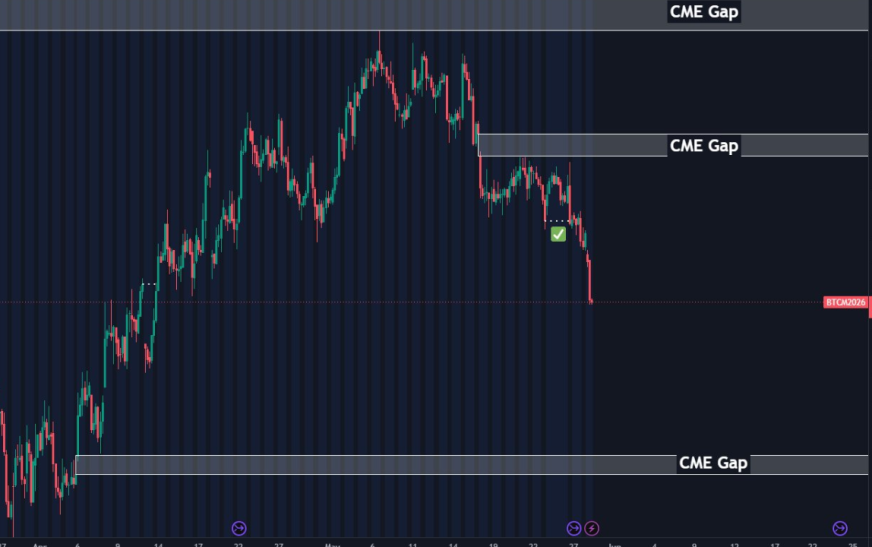
Bitcoin CME gap analysis is entering a new phase after Bitcoin began its first full trading week without a fresh CME futures gap, ending one of crypto’s most widely watched short-term technical patterns. According to the original BeInCrypto report published through TradingView, the Chicago Mercantile Exchange moved its regulated cryptocurrency futures and options to around-the-clock trading on May 29, removing the weekend closure that had created visible Bitcoin futures gaps since December 2017.
For years, traders watched CME Bitcoin futures gaps because the futures market closed over weekends while spot Bitcoin and offshore perpetual markets continued trading. If Bitcoin moved sharply between Friday’s futures close and Sunday’s reopening, the CME chart would show a gap. Many traders then watched whether BTC would “fill” that gap by returning to the missing price zone.
That pattern became one of the most recognized signals in crypto trading. Historical fill rates were often cited between 70% and more than 90%, making CME gaps a common reference point for short-term price targets. Now, with CME crypto products trading continuously, no new weekend gaps should form in the same way. The market must decide whether legacy gaps still matter and what traders should use next.
Why CME Gaps Became So Important
CME gaps mattered because they sat at the intersection of institutional futures trading and 24/7 crypto spot markets. Bitcoin itself never stops trading, but regulated futures historically did. That created a structural mismatch between traditional market hours and crypto’s always-open nature.
When Bitcoin moved during the weekend, CME futures reopened at a different level. The empty space on the chart became the “gap.” Many traders believed price had a tendency to revisit those areas because markets often retrace to rebalance liquidity, test untraded zones, or close technical inefficiencies.
Whether the gap-fill concept was causal or self-reinforcing is still debatable. Some traders viewed CME gaps as genuine liquidity magnets. Others argued they worked because so many market participants watched the same levels. In technical markets, that distinction can be blurry. If enough traders believe a level matters, their orders can make it matter.
For Bitcoin, CME gaps became part of the weekly playbook. Traders looked for upside gaps, downside gaps, and whether Monday price action would move toward the unfilled area. This made gap analysis especially popular during volatile weekends.
What Changed With 24/7 CME Crypto Trading
The key change is that CME now runs Bitcoin, Ether, Solana, and six other crypto contracts continuously. The report noted that daily maintenance windows now last two minutes on weekdays and two hours on Saturdays. That structure removes the long weekend closure that produced the traditional Bitcoin CME gap.
This is a major market-structure change. Institutions, ETF issuers, corporate treasuries, and portfolio managers now have a regulated venue to hedge crypto exposure during weekends. Previously, if a major event hit on Saturday or Sunday, institutions relying on CME could not adjust futures positions until the market reopened.
Continuous trading reduces that problem. It gives professional market participants more flexibility and may improve risk management. It also brings CME closer to the rhythm of spot crypto markets, which have always traded around the clock.
For traders, the impact is more complicated. One familiar signal is disappearing, but market efficiency may improve. That means fewer obvious chart gaps, but potentially better weekend liquidity and cleaner hedging.
Bitcoin’s First Gap-Free Monday Is Symbolic
Bitcoin’s first CME gap-free Monday is symbolic because it marks the end of an era. Since CME Bitcoin futures launched in December 2017, weekend gaps became part of crypto trading culture. Many traders began each week by checking whether a gap formed and where it sat.
Now, that habit changes. A Monday open without a new gap forces traders to rely more on other signals, including support and resistance, liquidity zones, open interest, funding rates, volatility, ETF flows, spot volume, macro data, and options positioning.
The change does not mean technical analysis becomes less useful. It means one specific technical signal becomes less relevant for new price action. Traders who built strategies around weekend CME gaps will need to adapt.
The first few weeks of continuous CME trading may be especially important because they will show how quickly institutional volume moves into weekend sessions and whether Monday volatility changes.
For broader updates on Bitcoin, crypto derivatives, institutional trading, and digital asset market structure, Finprozone latest market news provides regular coverage of market-moving crypto developments.
Legacy Gaps Still Remain on the Chart
Although no new weekend gaps should form under continuous trading, old gaps still exist. The report noted that three legacy gaps remain open on the Bitcoin chart: two above current price near $78,500 and $80,000, and one below in the $67,000 to $70,000 zone.
These levels may still attract attention because many traders already know them. The question is whether they retain the same pull now that the structural reason for new gaps has changed.
The answer is not obvious. Legacy gaps may continue to matter as technical reference points. They represent areas where historical CME futures trading skipped over price. Traders may still place orders around them, especially if BTC approaches those zones.
However, the market may gradually stop treating them as automatic magnets. If continuous trading reduces the importance of gaps going forward, traders may become less committed to gap-fill strategies over time.
For now, those three levels remain useful to watch. The upside gaps near $78,500 and $80,000 could act as bullish targets if Bitcoin rebounds. The lower gap between $67,000 and $70,000 could become a downside target if BTC loses support.
Bitcoin Price Still Needs Direction
Bitcoin traded near $73,441 on Sunday, down 3.7% for the week, after what the report described as one of the quietest weekends in recent memory. That quiet price action is important because it occurred during the transition to 24/7 CME trading.
A quieter weekend may reflect reduced gap-driven speculation, weaker volatility, or simple market hesitation. It is too early to draw firm conclusions from one weekend. Still, the lack of a new gap may reduce one source of Monday drama.
Bitcoin is now sitting between major legacy gap zones. Upside traders may watch whether BTC can move toward $78,500 and $80,000. Downside traders may watch whether weakness pulls the market toward the $67,000 to $70,000 area.
This creates a wide technical range. A move through either side could shape short-term sentiment. Until then, BTC remains in a post-gap transition zone where old signals are being tested and new behavior is still forming.
Institutional Traders Gain Better Weekend Risk Management
One of the biggest beneficiaries of 24/7 CME crypto trading may be institutional investors. CME cited record demand for digital asset risk management, with $3 trillion in notional volume across cryptocurrency futures and options in 2025, according to the report.
That figure shows how important regulated derivatives have become in crypto. Institutions often need compliant venues, reliable clearing, transparent margin structures, and recognized market infrastructure. CME provides that framework.
The shift to continuous trading helps institutions manage weekend exposure more effectively. ETF issuers, corporate treasuries, hedge funds, and asset managers can adjust hedges in real time rather than waiting for Sunday reopening.
This may reduce the gap between institutional and crypto-native market access. It may also help improve liquidity during periods that were previously difficult for regulated participants.
Over time, better institutional hedging could reduce weekend volatility. But it could also increase weekend activity if more professional traders participate outside traditional market hours.
Why the Change Matters for ETF Issuers and Treasuries
Spot Bitcoin ETF issuers and companies with Bitcoin exposure may benefit from continuous futures trading because it gives them more tools to manage risk. If Bitcoin moves sharply over the weekend, regulated futures can now provide a channel for hedging.
Corporate treasuries holding BTC may also find the change useful. A company with material Bitcoin exposure may not want to rely only on spot markets or offshore derivatives during weekend events. CME’s continuous model gives those firms another option.
This matters as Bitcoin becomes more institutional. The more BTC enters ETFs, corporate balance sheets, structured products, and professional portfolios, the more important regulated risk management becomes.
The end of new CME gaps is therefore not only a technical story. It is also a sign that Bitcoin market infrastructure is becoming more mature.
Bitcoin Volatility Futures Add Another Layer
The report also noted that Bitcoin Volatility futures are scheduled to debut on June 1. This contract tracks 30-day implied volatility and adds another tool for traders managing crypto risk.
Volatility products matter because traders may want exposure not only to price direction, but also to expected price movement. A volatility future can help institutions hedge or speculate on whether Bitcoin will become more or less volatile over a defined period.
This is especially relevant as CME trading becomes continuous. If weekend gaps disappear and liquidity improves, volatility patterns may change. Traders will want tools to manage that transition.
Bitcoin volatility remains one of the asset’s defining features. Products tied to implied volatility can deepen the derivatives market and make BTC more accessible to sophisticated strategies.
What Traders May Use Instead of CME Gaps
With new CME gaps disappearing, traders may shift attention to other signals. Liquidity zones could become more important. These are price areas where many stop-loss orders, liquidation levels, or resting orders may sit.
Open interest will also matter. Rising open interest can show increased positioning in futures markets. If price rises with open interest, traders may interpret that as growing participation. If price rises while open interest falls, the move may be driven more by short covering.
Funding rates on perpetual futures may remain important. Positive funding can show bullish leverage. Negative funding can show bearish pressure or crowded shorts.
Options data may also gain relevance. Implied volatility, open interest by strike, and dealer positioning can shape short-term price behavior, especially near major expiry dates.
In short, Bitcoin traders are not losing technical tools. They are losing one familiar shortcut.
Risks of Relying Too Much on Old Gap Logic
The biggest risk now is that traders continue treating old gap logic as if nothing has changed. Market structure has changed. That means old patterns may not behave the same way.
Legacy gaps can still matter, but traders should avoid assuming they must be filled quickly. The historical fill rate was based on a market structure that no longer exists. Once CME trades continuously, the mechanical reason for recurring weekend gaps disappears.
This does not invalidate all past technical analysis. It simply means traders should update probabilities. The market may still revisit $78,500, $80,000, or $67,000 to $70,000, but those moves should be judged alongside current liquidity, trend, volume, macro conditions, and derivatives positioning.
Bitcoin rewards adaptability. A signal that worked for years can lose power when market structure changes.
What Could Push Bitcoin Toward the Upside Gaps?
Bitcoin could move toward the $78,500 and $80,000 legacy gaps if buyers regain momentum. A stronger spot bid, improving ETF flows, rising institutional demand, weaker dollar conditions, or better risk appetite could all help.
A move above nearby resistance would likely bring the upper gaps back into focus. Traders who still monitor CME gaps may target those zones if BTC begins climbing.
The lack of new gaps may also make existing gaps more visible for a while. Since no fresh weekend gaps will distract attention, legacy gaps could remain the last major reference points from the old CME structure.
However, Bitcoin needs price confirmation. Without stronger volume and sustained buying, upside gap targets may remain only watchlist levels.
What Could Pull Bitcoin Toward the Lower Gap?
The lower gap between $67,000 and $70,000 could become relevant if BTC loses support. A risk-off move, stronger dollar, weaker ETF demand, rising yields, or broader crypto selloff could pull Bitcoin lower.
This lower zone may attract dip buyers because it is both a legacy gap area and a broad technical region. If BTC enters that range and stabilizes, traders may view it as a potential accumulation area.
If the zone fails, however, sentiment could weaken sharply. A decisive break below $67,000 would suggest that the market is not respecting the legacy gap as support and may be repricing deeper downside risk.
Bitcoin CME Gap Analysis Enters a Post-Gap Era
Bitcoin CME gap analysis is not dead, but it has changed. New weekend gaps should no longer form in the old way, which means traders must stop treating Monday gap checks as a standard part of the weekly routine.
The remaining legacy gaps may still matter because market participants continue to watch them. But their influence will now be tested under a different structure. If Bitcoin revisits the old gaps, traders may claim the signal still works. If BTC ignores them for extended periods, confidence in the gap-fill strategy may fade.
The bigger takeaway is that Bitcoin market infrastructure is maturing. Continuous CME trading gives institutions better weekend hedging, reduces structural disconnects, and pushes crypto closer to full-time professional market coverage.
For traders, the adjustment is clear: watch the old gap levels, but do not depend on them alone.
FAQ
What is a Bitcoin CME gap?
A Bitcoin CME gap was a price gap created when CME Bitcoin futures closed over the weekend while spot Bitcoin kept trading. If BTC moved before futures reopened, the CME chart showed an empty price zone that traders often expected Bitcoin to revisit.
Why will new CME gaps stop forming?
New weekend CME gaps should stop forming because CME moved regulated crypto futures and options to around-the-clock trading on May 29. Continuous trading removes the long weekend closure that previously created visible Monday gaps.
Do old Bitcoin CME gaps still matter?
Old gaps may still matter because traders continue watching them as technical reference levels. However, their influence is now being tested under a new market structure, so traders should not assume they will behave exactly like past gaps.
Where are the remaining Bitcoin CME gaps?
The report noted three remaining legacy gaps: two above current price near $78,500 and $80,000, and one below in the $67,000 to $70,000 zone. These levels may remain important short-term watch zones.
How should traders follow Bitcoin CME gap analysis now?
Traders should combine legacy gap levels with volume, open interest, ETF flows, options data, and broader crypto sentiment. For structured chart tracking and crypto comparisons, use market tools and trading resources to monitor Bitcoin and related signals.