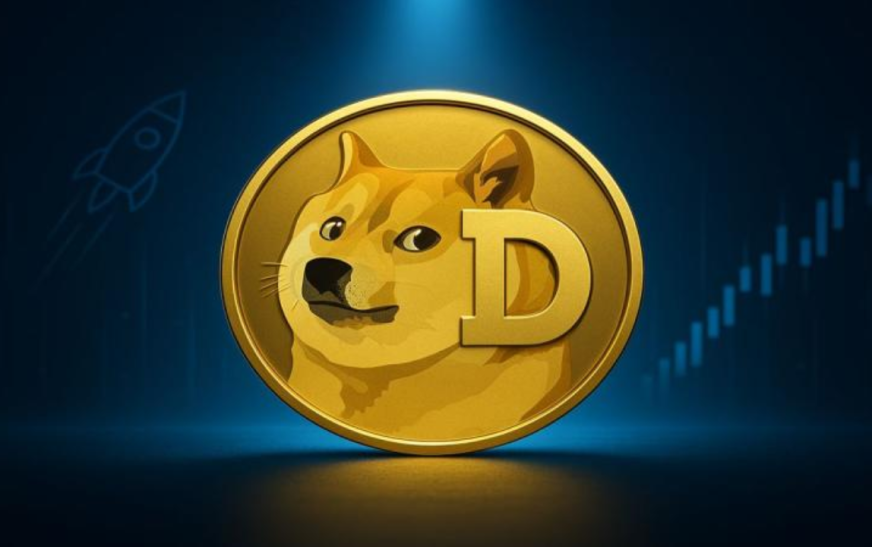
Dogecoin looks cheap, but the recovery is not simple
Dogecoin is showing one of the more interesting setups in the crypto market right now. On one side, several on-chain valuation metrics suggest that DOGE may be trading in deep-value territory after a long and painful drawdown. On the other side, fresh derivatives data shows that leverage is building quickly, while actual network activity appears to be weakening.
That creates a mixed and potentially unstable market structure. The token has gained 10.8% over the past 30 days, giving short-term traders something to work with. But the broader picture is still fragile. Dogecoin remains 42.75% lower year over year and continues to trade 22.27% below its 200-day moving average.
In other words, the recent bounce has not repaired the larger trend. It has improved momentum, but it has not yet confirmed a durable reversal.
According to the original NewsBTC report on Dogecoin on-chain data via TradingView, Alphractal’s latest data suggests that DOGE is historically cheap on-chain, but the rebound may be driven more by leveraged speculation than by renewed organic demand.
That distinction matters. A cheap asset can still fall if buyers are only borrowing conviction rather than building real demand.
Dogecoin’s MVRV ratio points to deep undervaluation
The strongest bullish argument for Dogecoin comes from valuation. Alphractal AI places DOGE’s MVRV ratio at 0.686. This means Dogecoin’s market capitalization is trading at a 31.4% discount to realized value.
The MVRV ratio compares market value with realized value. Market value reflects the current total value of the asset. Realized value estimates the value of coins based on the price at which they last moved. When MVRV falls below 1, it often means the market is trading below the average cost basis of holders.
Historically, this type of setup can appear during accumulation phases. It suggests many holders are underwater and that weaker participants may have already absorbed significant losses. Long-term buyers sometimes begin reassessing risk and reward when MVRV reaches depressed levels.
For Dogecoin, a 0.686 MVRV reading supports the view that the token is not expensive relative to its own history. The market has already repriced DOGE sharply lower. Many holders are holding losses. Sentiment has been damaged. These are often conditions that value-focused crypto traders watch carefully.
However, undervaluation is not the same thing as a buy signal. It shows that the asset may be cheap compared with its cost-basis history, but it does not guarantee immediate upside. For a stronger recovery, Dogecoin also needs demand, network activity and healthier market structure.
NUPL confirms holder capitulation
The second major valuation signal comes from Dogecoin’s NUPL, or Net Unrealized Profit/Loss. Alphractal’s data shows DOGE’s NUPL at -0.459, placing the asset in what the analysis describes as capitulation territory.
A negative NUPL reading means the average holder is sitting on unrealized losses. In Dogecoin’s case, the realized price is around $0.1383, while DOGE recently traded near $0.09922. That means many holders acquired their coins above the current market price.
This reinforces the deep-value argument. When average holders are underwater, selling pressure can eventually begin to exhaust itself. Investors who wanted to exit may already have sold, while remaining holders may become less willing to sell at depressed prices.
Still, capitulation can last longer than traders expect. Markets do not always rebound simply because holders are in pain. Sometimes capitulation marks the beginning of accumulation. Other times, it reflects a weak market that needs more time to rebuild confidence.
For Dogecoin, the NUPL data says the asset is deeply discounted. But to turn that discount into a sustained rally, DOGE needs more than valuation. It needs evidence that demand is returning.
For broader coverage of crypto, macro and market developments, readers can follow Finprozone latest market news.
The broader trend remains technically fragile
Dogecoin’s short-term rebound looks constructive, but the broader trend still deserves caution. The token remains more than 22% below its 200-day moving average, a commonly watched long-term trend indicator.
When an asset trades below its 200-day moving average, many technical traders view the broader structure as weak. It does not mean the asset cannot rally. It means the market has not yet regained a stronger long-term trend profile.
The year-over-year decline of 42.75% also shows that the recent 30-day recovery is still small compared with the scale of the previous drawdown. A 10.8% monthly gain can improve sentiment, but it does not erase a year of weakness.
This is where Dogecoin’s setup becomes complicated. On-chain valuation says DOGE looks cheap. Price momentum says a short-term bounce is underway. But trend structure says the larger market still has work to do.
For traders, that means risk management is important. Buying into undervaluation can work well if the market begins a new accumulation cycle. It can also become painful if the bounce fails and price returns to lower support zones.
Leverage is building quickly in Dogecoin
While spot-market structure remains fragile, derivatives positioning has turned aggressively bullish. Dogecoin open interest has climbed 15.73% over the past week to $1.02 billion. That equals about 6.05% of Dogecoin’s market capitalization.
Open interest measures the total value of outstanding derivatives contracts. Rising open interest means more traders are entering leveraged positions. This can support momentum when price is moving in the same direction as positioning. But it can also increase liquidation risk if the market turns.
The long/short ratio currently stands at 2.057, meaning leveraged traders are positioned more than two-to-one toward the upside. That is a strong bullish skew.
This kind of positioning can create short-term upward pressure if buyers keep control. But it also creates crowding risk. When too many traders are leaning in the same direction, the market becomes vulnerable to sudden liquidation events.
If DOGE rises, leverage can amplify gains. If DOGE falls, the same leverage can accelerate downside.
Whale and top-trader sentiment is heavily bullish
The derivatives picture becomes even more aggressive when looking at larger traders. Alphractal reported a positive whale-versus-retail delta of 0.843, suggesting that larger traders are building long exposure.
Top trader sentiment is even more bullish, at 2.748. This indicates that more sophisticated or higher-volume traders are leaning strongly toward the upside.
At first, this may look supportive. If whales and top traders are building longs, some market participants may read that as a vote of confidence. Larger traders often have more resources, better data and stronger execution capabilities.
But this also raises the stakes. When large traders crowd into long positions, their exits can become important. If price stalls or reverses, the same large leveraged positions that supported the bounce can become a source of forced selling.
This is especially true in a market where network activity is weakening. If leverage is rising while real usage is falling, the rally becomes more dependent on speculative positioning than organic demand.
That is not automatically bearish, but it does make the structure more fragile.
Liquidations are still contained, but risk is rising
Dogecoin’s 24-hour liquidations were relatively contained at $1.99 million, with shorts accounting for $1.10 million and longs for $891,000. These numbers do not yet suggest a major liquidation event.
However, the risk is not in current liquidations. The risk is in rising open interest combined with one-sided positioning. As leverage builds, the market becomes more sensitive to sharp price moves.
If DOGE pushes higher, short sellers may face pressure and upside could extend. But if DOGE fails to hold key levels, overleveraged longs could be forced out. That could turn a normal pullback into a sharper move.
This is why leverage needs to be watched carefully. It can make a rally look stronger than it really is. It can also make a decline faster than expected.
For Dogecoin, the market is not yet in a liquidation crisis. But the conditions for larger volatility are forming.
Network activity is the weakest part of the setup
The most concerning part of the Dogecoin report is not price. It is network activity.
Daily active addresses fell 38.35% in 24 hours to 37,197 and are down 44.88% over seven days. Daily transactions dropped even more sharply, falling 64.30% in a single day to 26,189 and declining 51.27% over the week.
Adjusted transfer value also fell 41.94% to $118.12 million.
These numbers create a clear divergence. Traders are increasing leveraged exposure, but actual network usage is fading. That means the recent Dogecoin price bounce may not be supported by stronger adoption, payments activity or transactional demand.
This is the core risk. A healthy rally is usually stronger when price, volume, user activity and network demand improve together. Dogecoin currently shows price recovery and bullish leverage, but weak network activity.
That kind of rally can continue for a while, especially in a speculative market. But it is more vulnerable to reversal if sentiment changes.
Exchange reserves add another layer of caution
Exchange balances are another warning signal. Dogecoin reserves rose 9.95% over the week to 27.52 billion DOGE, worth roughly $2.68 billion.
Rising exchange reserves can mean more coins are available for sale. When holders move coins to exchanges, it may indicate they are preparing to trade or sell. This is not always bearish by itself, but it becomes more concerning when combined with weak network activity and rising leverage.
If more DOGE is sitting on exchanges while organic demand is falling, the market may face increased supply risk. A leveraged rally can absorb that supply while sentiment is strong. But if price momentum weakens, available exchange supply can become a source of pressure.
This is why the Dogecoin setup is not straightforward. On-chain valuation looks attractive, but exchange data and activity metrics are not confirming a strong demand recovery.
Cheap does not always mean safe
The biggest mistake traders can make in this setup is assuming that cheap automatically means safe. Dogecoin may look undervalued based on MVRV and NUPL, but undervaluation alone does not remove downside risk.
An asset can remain undervalued for months if demand stays weak. It can also become more undervalued if leverage unwinds or broader crypto sentiment turns negative.
The better interpretation is that Dogecoin offers a potentially attractive risk-reward setup only if demand begins to recover. Traders need confirmation from network activity, spot demand, exchange outflows or stronger trend structure.
Without confirmation, the current bounce may be more speculative than structural.
What Dogecoin traders should watch next
Dogecoin traders should watch four signals closely.
First, active addresses and daily transactions need to stabilize. If network activity keeps falling, the rally becomes harder to trust.
Second, exchange reserves should be monitored. A decline in reserves would suggest less available supply for sale, while continued increases could raise distribution risk.
Third, open interest and long/short ratios matter. If leverage keeps rising while price stalls, liquidation risk increases.
Fourth, DOGE needs to reclaim stronger technical levels, including the 200-day moving average, to improve the broader trend.
For now, Dogecoin is caught between value and leverage. That can produce sharp moves, but it also requires caution.
Conclusion
Dogecoin looks cheap based on several on-chain valuation metrics. Its MVRV ratio of 0.686 suggests the market is trading at a 31.4% discount to realized value, while its NUPL reading of -0.459 confirms that many holders remain underwater. These are conditions often associated with capitulation and possible accumulation.
But the bullish case is not clean. Open interest has jumped 15.73% to $1.02 billion, the long/short ratio is heavily tilted toward longs, and whale positioning is strongly bullish. At the same time, daily active addresses, transaction counts and adjusted transfer value have fallen sharply.
That creates a risky divergence. Dogecoin may be undervalued, but the latest bounce appears to be driven more by leveraged speculation than by stronger network demand. Rising exchange reserves add another layer of caution, suggesting more supply may be available for sale.
The next move will depend on whether DOGE can convert cheap valuation into real demand. Until network activity improves, traders should treat the rally as promising but fragile.
FAQ
Why does Dogecoin look undervalued on-chain?
Dogecoin looks undervalued because its MVRV ratio is below 1, meaning market value is below realized value. Its NUPL is also negative, showing that many holders are underwater. Historically, these conditions can appear near accumulation zones, but they do not guarantee an immediate recovery.
Why is rising leverage risky for Dogecoin?
Rising leverage is risky because it can amplify price moves in both directions. If DOGE keeps rising, leveraged longs may support momentum. But if price reverses, crowded long positions can trigger liquidations and accelerate downside pressure.
Is Dogecoin network activity improving?
No. Recent data shows Dogecoin network activity has weakened sharply. Daily active addresses, daily transactions and adjusted transfer value all declined. This suggests the latest price bounce may be driven more by speculation than by stronger organic usage.
What does rising Dogecoin exchange reserves mean?
Rising exchange reserves can mean more DOGE is available for trading or sale. When reserves increase while network activity weakens, it may signal potential selling pressure. Traders should watch whether exchange balances continue rising or begin to decline.
What should Dogecoin traders watch next?
Dogecoin traders should watch active addresses, daily transactions, exchange reserves, open interest and the long/short ratio. For deeper context on market behavior and risk management, readers can explore Finprozone’s market tools and trading resources.