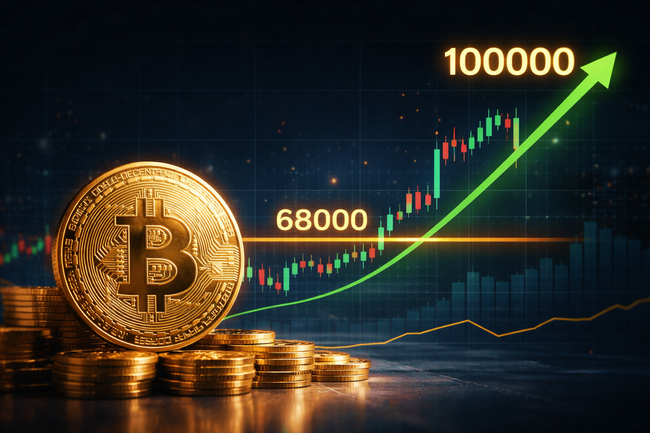
Bitcoin traded near $68,200 on Wednesday as global markets digested a sharp sell-off in South Korea’s stock market and fresh geopolitical tension in the Middle East. While equities whipsawed and energy headlines dominated risk sentiment, Bitcoin held its ground—an outcome that feels notable in a world where “macro stress” usually means “crypto stress.”
Over the past 24 hours, Bitcoin rose roughly 0.7%, after briefly slipping below $67,500 earlier in the week. Data in your notes shows BTC held above a 24-hour low of $67,406, while trading volumes picked up during early Asian hours—often a sign that traders are positioning around headline risk rather than drifting on low liquidity.
The bigger story, though, is not Bitcoin’s small move. It’s the contrast: a major Asian equity market experienced a violent drawdown, yet BTC stayed range-bound. That doesn’t crown Bitcoin a safe haven overnight, but it does underline a familiar truth: in periods of stress, Bitcoin can behave more like a “global liquidity barometer” than a simple tech proxy—sometimes selling off hard, sometimes holding steady, depending on what the market decides to fear most.
Korea’s market shock: what happened, and why it matters
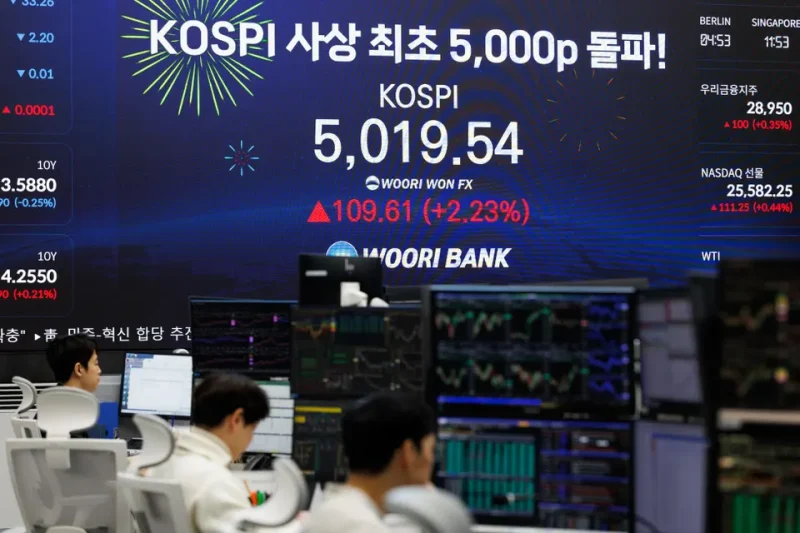
South Korea’s benchmark KOSPI plunged more than 10% during Wednesday trading, triggering a circuit breaker after an earlier 8% drop temporarily halted trading. The sell-off erased an estimated $270 billion in market value in a single session, with heavyweight semiconductor names leading the slide.
- Samsung Electronics fell about 10%
- SK Hynix dropped roughly 12%
This is the kind of move that instantly shifts the mood from “risk management” to “risk avoidance.” When a major index gaps down and hits circuit breakers, investors start asking two questions at once:
- Is this an isolated domestic shock—or the first domino in a regional/global repricing?
- What new information forced this kind of forced de-risking now?
Even if the answer is “it’s local,” global portfolios still react. South Korea sits at the crossroads of the global manufacturing chain, particularly for chips and memory. A sudden equity shock there can spill into global sentiment, not necessarily because the fundamentals change overnight, but because the market re-prices the probability of broader disruptions.
Oil above $80 and Hormuz anxiety: why Korea is extra sensitive
Your notes tie part of the stress to energy markets: oil climbed above $80 amid tension in the Middle East and concern about shipping through the Strait of Hormuz. That’s not just an oil story—it’s an inflation and supply-chain story.
South Korea imports most of its energy supply. When energy costs spike, the pressure is not abstract:
- input costs rise (power, transport, manufacturing)
- margin assumptions get squeezed
- currency and trade balance expectations can shift
- and for high-throughput industries, even small changes in energy pricing can ripple through planning
Semiconductors are especially sensitive to cost stability. High-end chip manufacturing is energy- and infrastructure-intensive. If markets start pricing prolonged energy volatility, it becomes easier to justify de-risking in the sector—even if demand for chips remains strong.
And chips aren’t just “electronics” anymore. They sit at the heart of AI infrastructure. That makes the global chip sector a kind of proxy for the AI buildout—particularly components like high-bandwidth memory (HBM) used in advanced computing systems.
So when Korean chip leaders get hit hard in a single session, the market isn’t only selling “Korea.” It’s also repricing the risk around the global AI supply chain and its cost base, especially when geopolitical headlines are pushing oil higher.
Why Bitcoin didn’t crack: stability can be its own signal
With Asian equities dropping sharply, Bitcoin remained relatively stable, still trading inside a consolidation band between roughly $67,000 and $70,000.
That stability can be interpreted in a few ways—none of them perfect, all of them useful:
1) Crypto has already been de-risked
If a market has already spent weeks getting punished, it sometimes stops reacting to new bad news the way it used to. Not because things got good, but because positioning got lighter. When fewer traders are over-levered on the long side, fewer forced liquidations occur on every headline.
2) Bitcoin trades 24/7 and absorbs stress in real time
Bitcoin often moves first when global risk shifts, simply because it’s always open. If BTC already reacted earlier in the week by dipping below $67,500, it may have “priced” more of the risk before the KOSPI’s worst prints hit the tape.
3) Some investors still treat BTC as a hedge during geopolitical shocks
This narrative is inconsistent over short windows—Bitcoin is not reliably “digital gold.” But during certain geopolitical periods, flows can rotate into BTC as investors seek assets outside any single country’s financial system. That can support price even when equities struggle.
The key point: Bitcoin holding steady doesn’t prove a new regime. It suggests the market hasn’t agreed that “today is the day” to push BTC out of its range.

Institutional demand: ETF inflows keep the floor from feeling hollow
Institutional flows remain a major swing factor in Bitcoin’s market structure, especially in uncertain macro environments.
Your notes cite spot Bitcoin ETF filings showing BlackRock’s fund purchased roughly $264 million worth of Bitcoin within the past 24 hours. Whether the market is euphoric or anxious, that kind of absorption matters. It doesn’t guarantee upside, but it can reduce the probability of disorderly downside—particularly when spot demand is visible and consistent.
This is one of the biggest differences between today’s Bitcoin market and earlier eras:
- In past cycles, bearish phases were often dominated by leverage flushes and retail capitulation.
- In newer cycles, the presence of large structural buyers can change the speed and shape of downturns—even if they don’t prevent them.
ETF flows also send a psychological message: “someone with a long horizon is still buying.” Markets don’t run purely on psychology, but they absolutely trade on it.
Technical picture: range-bound, but not “safe”
Technically, Bitcoin is still in consolidation, but consolidation doesn’t mean comfort. It often means tension.
Upside scenario: reclaiming $70,000
A daily close above $70,000 would strengthen the bullish structure and could open a path toward $77,000—not because $77,000 is magical, but because breakouts from tight ranges often seek the next high-liquidity zone.
If Bitcoin can close above the top of its consolidation range, traders often interpret it as a shift from “distribution” to “re-accumulation,” at least temporarily.
Downside scenario: loss of structure below $62,000
On the downside, your notes flag that a close below $62,000 would weaken market structure and increase the risk of a deeper correction. That level matters because it signals the range has failed—and range failures tend to accelerate as stop-losses cluster and liquidity thins.
The bear-flag risk
You also note current price action forms a bear flag pattern, which historically can lead to a downward breakout if selling pressure increases. The “if” is important. Bear flags aren’t destiny; they’re a probability frame. They become meaningful when volume and momentum confirm the breakdown.
In other words: the market is still deciding whether this is a pause before another drop, or a base before a rebound.
What’s next: key levels traders will keep circling
Bitcoin’s next move is still likely to be dictated by a mix of headlines, flows, and technical triggers. Several levels stand out based on your notes:
Major support zones
- $54,000–$57,000 as a major support region
- ~$55,000 as a historically strong horizontal support level during prior corrections
These levels represent areas where buyers previously showed up with conviction. Markets remember those zones—especially in crypto, where crowd psychology is half the game.
Key resistance
Bitcoin continues to face resistance near the top of its current range (near $70,000), a level it has struggled to break in recent sessions. That’s the ceiling the market has to clear to change the narrative from “defensive” to “constructive.”
Bottom line: Bitcoin is stable, but the world isn’t
South Korea’s equity crash, oil’s jump above $80, and renewed Middle East tension are the kinds of stressors that can flip global portfolios into risk-off mode fast. Yet Bitcoin is still holding near $68,000—less like a victory and more like a sign that the market is waiting for confirmation.
If BTC breaks above $70,000 and holds, the range can become a launchpad. If it loses key supports and sentiment deteriorates, the mid-$50,000s move back into view. For now, Bitcoin is behaving like a market caught between two forces: macro anxiety that wants to de-risk, and structural demand that refuses to disappear.