

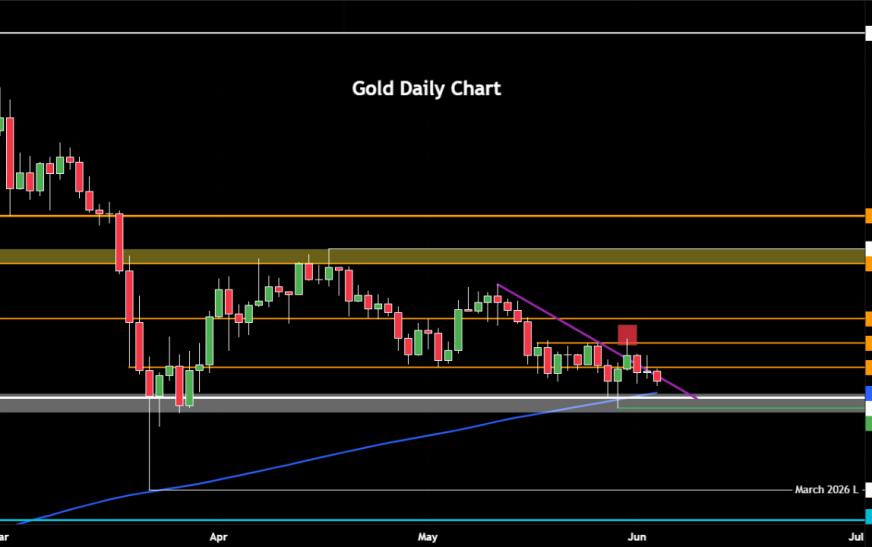
Gold steadied on Tuesday as traders waited for clearer signals from Middle East developments and upcoming U.S. labor-market data. The latest gold price forecast remains cautious because bullion is being pulled between safe-haven demand, inflation concerns, interest-rate expectations, oil-price volatility, and the U.S. dollar.
According to the original Reuters report published through TradingView, spot gold was little changed at $4,486.32 per ounce as of 2:11 p.m. EDT after falling as much as 2% on Monday. U.S. gold futures settled 0.3% higher at $4,519.90. The move reflected a market waiting for direction rather than a decisive shift in sentiment.
The key issue is that gold’s traditional role as a hedge is being complicated by the same factors that usually support it. Middle East uncertainty can lift safe-haven demand, but higher energy prices can also keep inflation risks elevated. If inflation pressure keeps bond yields and interest-rate expectations high, gold can lose some appeal because it does not provide income. That leaves bullion in a difficult balance.
Gold Holds Steady After Monday’s Pullback
Gold’s stabilization followed a volatile start to the week. After dropping as much as 2% on Monday, bullion found a calmer tone on Tuesday, but the recovery was limited. Spot gold remained near $4,486, while U.S. futures settled slightly higher.
This type of price action suggests hesitation rather than conviction. Buyers have not fully regained control, but sellers have also failed to extend Monday’s decline. In the short term, that leaves the gold price forecast dependent on external catalysts.
The main catalysts are clear: Middle East developments, oil prices, bond yields, the U.S. dollar, and incoming U.S. economic data. When these signals align, gold can move quickly. When they point in different directions, the market can become choppy and directionless.
Fawad Razaqzada, market analyst at Forex.com, said gold’s trajectory depends on oil prices, bond yields, and the U.S. dollar, with all three tied to the Middle East situation. That is a useful framework for understanding the current setup. Gold is not trading on one factor alone. It is reacting to a chain of connected macro and geopolitical signals.
Middle East Uncertainty Keeps Traders Cautious
The Middle East remains central to the current gold price forecast. Iran is reviewing a proposed agreement with the U.S. to halt the war, but Iranian media reported that Tehran had not communicated with Washington for several days. At the same time, U.S. President Donald Trump said negotiations were ongoing.
This uncertainty has left traders reluctant to take aggressive positions. If a deal appears more likely, oil prices may ease and inflation concerns could moderate. That could reduce some safe-haven demand for gold, but it may also lower yields and support bullion indirectly. If talks stall or tensions intensify, gold may attract defensive demand, but rising oil prices could complicate the picture by reinforcing inflation risk.
That contradiction is important. Gold does not always rise during geopolitical stress if the market believes the stress will keep interest rates higher for longer. Since the start of the conflict, gold has come under pressure because the surge in energy prices increased inflation worries and strengthened expectations that interest rates may remain elevated.
For investors, the lesson is that geopolitical risk alone is not enough. The market needs to judge how that risk affects inflation, monetary policy, and real yields. Those channels often determine whether gold benefits from uncertainty or struggles under higher-rate expectations.
Why Oil Prices Matter for Gold
Oil prices are a major part of the gold story because energy costs affect inflation expectations. When oil prices rise sharply, businesses and consumers face higher costs. That can pressure central banks to keep policy tighter, especially if energy inflation spreads into broader prices.
Gold is often described as an inflation hedge, but the relationship is not automatic. If inflation rises and central banks respond with higher interest rates, gold can weaken because investors have more attractive yield-bearing alternatives. Higher yields increase the opportunity cost of holding bullion.
That is why the current gold price forecast depends heavily on the direction of oil. If Middle East tensions push oil higher, gold could see safe-haven demand, but it could also face pressure from rising bond yields and a firmer policy outlook. If oil falls because negotiations improve, inflation expectations may ease, which could eventually help gold if yields decline.
In this environment, traders are not only watching gold charts. They are also watching crude oil, Treasury yields, the dollar, and geopolitical headlines together. A gold rally would likely look more convincing if it came alongside lower yields, a softer dollar, and renewed buying momentum.
U.S. Jobs Data Could Shape Fed Expectations
The next major test for gold comes from U.S. economic data. The ADP employment report is due Wednesday, followed by Friday’s employment report. Markets will review both for clues about the Federal Reserve’s policy path.
Labor-market data matters because it can influence expectations for interest rates. Strong employment data may suggest the economy can tolerate tighter policy for longer, which could pressure gold. Weaker data may support expectations that the Federal Reserve could eventually shift toward a less restrictive stance, which may help bullion.
The source report also noted that U.S. job openings increased more than expected in April, while hiring declined, likely reflecting lingering economic uncertainty. That mixed signal adds to the market’s hesitation. More openings can suggest labor demand remains firm, but softer hiring can point to caution among employers.
For gold, the ideal bullish setup would likely involve data soft enough to reduce rate pressure but not weak enough to trigger a broad liquidation across risk assets. A sharp deterioration in data could produce defensive buying, but it could also create liquidity-driven volatility across commodities and currencies.
For broader coverage of major data releases, policy expectations, and market reactions, readers can follow Finprozone latest market news as investors assess how labor-market signals affect metals, bonds, and currencies.
Bond Yields and the Dollar Remain Key Drivers
Bond yields and the U.S. dollar are two of the most important variables for gold. When yields rise, gold often struggles because it does not generate interest. When the dollar strengthens, gold can become more expensive for buyers using other currencies. The combination of higher yields and a stronger dollar can create a difficult environment for bullion.
At the moment, traders are waiting to see whether U.S. data reinforces or challenges expectations of elevated rates. If the employment report points to resilient labor conditions, yields may remain firm and gold could stay under pressure. If the data disappoints, yields may fall and the dollar could weaken, creating a more supportive backdrop.
The dollar’s reaction is especially important because gold is globally traded and priced in dollars. A softer dollar can increase international demand by making gold cheaper in other currencies. A stronger dollar can have the opposite effect.
This is why gold currently appears directionless. The market has not yet received enough confirmation from yields, currencies, or geopolitics to establish a stronger trend. A clearer move may require either renewed upside momentum in gold itself or a decisive macro signal from U.S. data.
Commerzbank Cuts Year-End Gold Forecast
Commerzbank lowered its year-end gold price forecast to $4,800 per troy ounce, down from its previous forecast of $5,000. However, the bank maintained its forecast of $5,200 for the end of 2027 and said structural factors supporting gold remain intact.
This revision is important because it reflects a more cautious near-term view without abandoning the longer-term bullish case. In other words, analysts may still see support for gold over time, but the immediate path has become less straightforward.
The reduced year-end target suggests that near-term pressure from rates, the dollar, or market positioning may limit upside. The unchanged 2027 forecast suggests that longer-term drivers remain relevant. These could include reserve diversification, investor demand, inflation protection, and geopolitical uncertainty.
For traders, the difference between short-term and long-term forecasts matters. A positive long-term view does not prevent short-term pullbacks. Investors who want gold exposure may still need to consider timing, volatility, and the risk of further consolidation before a stronger rally develops.
Silver, Platinum, and Palladium Also Gain
Other precious metals traded higher alongside gold’s stabilization. Spot silver rose 0.5% to $75.17 per ounce. Platinum gained 0.5% to $1,933.07, while palladium added 0.6% to $1,370.16.
The gains show that the precious-metals complex remained supported despite gold’s lack of strong direction. Silver’s move was notable because Commerzbank also pointed to weaker industrial demand for silver as a reason for a slightly lower silver-price view.
Silver is more exposed to industrial demand than gold, which makes it sensitive to both macro growth expectations and precious-metals sentiment. Platinum and palladium also have industrial links, especially through automotive and manufacturing demand. Their gains suggest that metals traders were not broadly exiting the space, even as gold waited for stronger confirmation.
Still, gold remains the central macro metal in this setup. Its next move will likely depend more on rates, the dollar, and geopolitical developments than on industrial demand. Silver and platinum-group metals may follow broader metals sentiment but can also diverge if industrial-demand expectations change.
What Traders Should Watch Next
The gold price forecast now depends on a narrow set of signals. First, traders should watch whether gold can regain upside momentum after Monday’s decline. A steady market is not enough to confirm renewed bullish pressure. Buyers need to show stronger demand near current levels.
Second, oil prices remain critical. If Middle East developments push oil sharply higher, inflation worries could keep rate expectations elevated. If oil stabilizes or declines, gold may benefit from lower inflation pressure if yields also ease.
Third, the dollar and bond yields should be monitored closely after the ADP and Friday employment reports. A softer dollar and lower yields would likely improve gold’s technical and macro backdrop. Stronger yields or a firmer dollar could keep the metal capped.
Finally, investors should watch whether Commerzbank’s lowered year-end target becomes part of a broader shift among analysts. If more institutions cut short-term forecasts, sentiment may remain cautious. If long-term targets stay firm, the market may treat pullbacks as consolidation rather than trend reversal.
FAQ
Why is gold steady instead of rallying on Middle East tensions?
Gold is steady because Middle East risk is creating mixed signals. Geopolitical uncertainty can support safe-haven demand, but higher oil prices can increase inflation concerns and keep interest-rate expectations elevated. Since gold does not offer yield, higher-rate expectations can limit its upside.
What U.S. data matters most for the gold price forecast?
The ADP employment report and Friday’s employment report are the key releases. Traders will use them to assess the Federal Reserve’s policy path. Strong labor data could support higher yields and pressure gold, while softer data may help bullion if it weakens the dollar and lowers rate expectations.
Why did Commerzbank cut its gold forecast?
Commerzbank lowered its year-end gold forecast to $4,800 from $5,000, suggesting a more cautious near-term view. However, it maintained its $5,200 forecast for the end of 2027 and said structural support for gold remains intact, keeping the longer-term case alive.
What should traders monitor next for gold?
Traders should watch oil prices, bond yields, the U.S. dollar, Middle East developments, and employment data. For scheduled macro releases that can affect metals and Federal Reserve expectations, follow the economic calendar for upcoming market events to track key catalysts.








1 Comment
[…] U.S.-Israeli war on Iran. Lower crude can weigh on agricultural commodities through biofuel demand, inflation expectations, and broader commodity […]
Comments are closed.