European wheat prices moved lower on Monday as a stronger euro weighed on export competitiveness and thin holiday trading reduced market momentum. The latest wheat price forecast has turned more cautious, with traders balancing currency pressure, weak U.S. market signals from the previous session, and limited direction because Chicago grain futures were closed for the Memorial Day holiday.
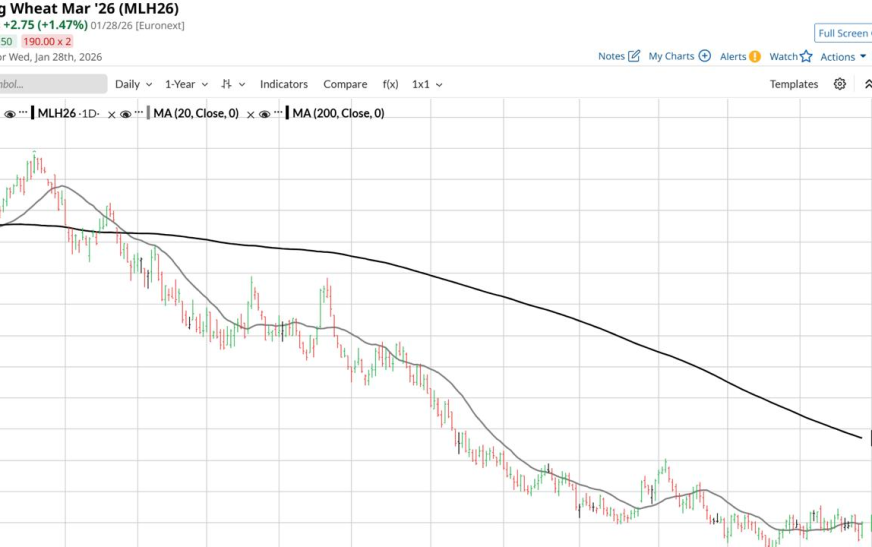
According to the original Reuters report published through TradingView, benchmark September milling wheat on Paris-based Euronext fell 1% to €212.75 per metric ton by 1545 GMT. The decline came as the euro gained against the dollar, making euro-denominated agricultural exports less competitive in global trade.
The move was not dramatic, but it mattered. Wheat futures are highly sensitive to currency shifts because export demand depends not only on crop supply and buyer interest, but also on how European prices compare with competing origins. When the euro rises, European wheat can become more expensive for international buyers, particularly in dollar-based trade channels.
Strong Euro Weighs on European Wheat
The euro-dollar exchange rate was the key pressure point for Euronext wheat. Reuters reported that the euro traded around 1.16 against the dollar, up 0.37% on the day. For European grain exporters, a firmer euro can reduce price competitiveness because buyers using dollars may find EU-origin wheat less attractive compared with supplies from other regions.
This is especially relevant for milling wheat, where global tenders and import demand often compare offers from Europe, the Black Sea region, North America, and other suppliers. Even when underlying crop fundamentals are stable, currency moves can quickly shift the relative appeal of one origin over another.
For the wheat price forecast, the stronger euro creates a short-term headwind. If the currency continues to rise, Euronext wheat may struggle to attract fresh buying unless there is a separate supportive catalyst, such as stronger export demand, weather concerns, or a rally in competing grain markets.
Currency pressure also affects trader psychology. When wheat futures decline on foreign-exchange moves rather than a major change in crop supply, the market may become more reactive to macro headlines. That can make price action uneven, especially during sessions with low volume.
Thin Holiday Trade Limits Market Direction
Monday’s decline also came during a session with unusually thin liquidity. The Chicago Board of Trade was closed for the U.S. Memorial Day holiday, while the Pentecost public holiday affected activity in nearly half of European Union countries. With both U.S. grain futures unavailable and many European traders away from the market, Euronext prices moved without the usual depth of global participation.
Thin trading conditions can exaggerate price moves or make them less reliable as signals. A 1% drop in Euronext wheat during a full-volume session may carry more conviction than the same move during a holiday session. In low-liquidity environments, fewer orders can move prices more easily, and some market participants may avoid taking strong positions until full trading resumes.
This matters for anyone assessing the wheat price forecast. Monday’s weakness shows that sellers had the upper hand, but the move may need confirmation when Chicago reopens and broader participation returns. If CBOT wheat resumes lower, the pressure on European wheat could intensify. If Chicago stabilizes or rebounds, Euronext may recover some ground.
The lack of U.S. market guidance was particularly important because CBOT wheat remains a major reference point for global grain sentiment. Even though European wheat has its own supply-demand structure, traders frequently watch Chicago futures for broader risk appetite, speculative positioning, and global grain-market direction.
Weak U.S. Close Adds Pressure
European wheat also followed the weaker tone from U.S. markets at the end of the previous week. Reuters noted that Euronext’s decline came after a weak close on U.S. markets on Friday before the holiday weekend. Although CBOT was closed on Monday, the last available U.S. signal was still bearish enough to influence sentiment.
Benchmark CBOT wheat was listed at 646.25 U.S. cents per bushel with no change during the closure. CBOT corn was also unchanged at 463.25 cents per bushel, while soybeans were unchanged at 1196.50 cents per bushel. Those unchanged readings reflected the market closure rather than active stability.
Because there was no new U.S. futures activity, European traders had limited confirmation from global grain benchmarks. This left the euro’s strength and the previous weak U.S. close as the main directional inputs.
In this type of environment, the wheat price forecast depends heavily on what happens when full market participation returns. A renewed decline in CBOT wheat would likely reinforce bearish pressure on Paris milling wheat. A rebound could help offset the currency-driven drag, especially if European exporters find demand support at lower price levels.
For broader commodity and futures coverage, traders can follow Finprozone latest market news as currency moves, holiday schedules, and global grain benchmarks continue shaping short-term market direction.
Why Currency Strength Matters for Grain Exports
Currency movements can be just as important as crop data in agricultural futures. Wheat is a globally traded commodity, and international buyers compare offers across regions. When the euro strengthens against the dollar, EU wheat may become more expensive for importers who benchmark purchases in dollars.
This does not automatically eliminate demand, but it can reduce competitiveness at the margin. Buyers may delay purchases, negotiate harder, or shift attention to alternative origins if European prices do not adjust lower. Futures markets often react before physical trade data confirms a change because traders anticipate how currency moves could affect export flows.
The impact is especially visible when there is no offsetting bullish catalyst. If weather risks were rising or export demand were exceptionally strong, Euronext wheat might absorb a stronger euro more easily. In Monday’s session, however, the market lacked fresh supportive news, leaving the currency move as the dominant driver.
For the wheat price forecast, sustained euro strength could keep pressure on Paris futures. A weaker euro, by contrast, could help restore export competitiveness and support prices if buyers return.
Paris Wheat, Maize, and Rapeseed All Weaken
The weakness was not limited to wheat. Paris maize and rapeseed also declined, suggesting broader pressure across European agricultural futures. Paris maize fell 1.11% to €221.75, while Paris rapeseed dropped 2.04% to €515.75.
The sharper decline in rapeseed showed that oilseed markets were also under pressure, possibly reflecting broader commodity sentiment and cross-market moves. While the Reuters source focused mainly on wheat, the wider decline in Paris contracts indicates that traders were not treating Monday’s session as an isolated wheat-specific move.
This broader weakness matters because grain and oilseed markets often influence each other through feed demand, acreage expectations, energy markets, and currency effects. When multiple agricultural futures decline at the same time, it can suggest that macro pressure is affecting the entire complex rather than one contract alone.
However, the holiday-thinned session again limits the strength of any conclusion. The market will need more active participation before traders can determine whether Monday’s decline marks the start of a deeper move or simply a low-volume reaction to currency and external-market pressure.
Oil, the Dollar, and the Macro Link
The Reuters report also connected the dollar’s decline to hopes of a possible deal to reopen the Strait of Hormuz, which pushed oil prices below $100 per barrel. That link is important because commodity markets are increasingly interconnected through inflation expectations, currency moves, and broader risk sentiment.
Lower oil prices can reduce inflation pressure and influence expectations for interest rates. Those shifts can affect currencies, including the dollar and euro. When the dollar weakens, the euro often strengthens, which can then pressure euro-denominated exports such as European wheat.
This chain reaction shows why the wheat price forecast cannot be analyzed only through crop fundamentals. Energy markets, geopolitical headlines, foreign-exchange flows, and central bank expectations can all feed into agricultural futures.
For wheat traders, the key question is whether the stronger euro is a temporary reaction to energy headlines or the beginning of a more persistent currency trend. If the euro remains firm, European wheat may need to fall further to stay competitive. If the dollar recovers, some of the pressure on Euronext wheat could fade.
Key Levels Traders Should Watch
The immediate reference point for Euronext wheat is the September contract’s move to €212.75 per metric ton. A sustained break lower from this area could signal that sellers remain in control, particularly if full-volume trading confirms the move after the holiday period.
Traders should also watch whether wheat can recover toward the previous session’s levels. If prices rebound quickly, Monday’s drop may be viewed as a low-liquidity reaction rather than a decisive shift. If prices remain under pressure, the market may begin pricing in a weaker export outlook.
The euro-dollar exchange rate remains another critical signal. A move higher in the euro could continue weighing on Euronext wheat. A pullback in the euro could give wheat futures some breathing room, especially if CBOT prices stabilize.
CBOT wheat will also be important when trading resumes. Because Chicago was closed on Monday, European wheat lacked an active U.S. benchmark. Once CBOT reopens, the relative performance between Paris and Chicago wheat may clarify whether pressure is local, currency-driven, or part of a broader global grain decline.
Risks to the Wheat Price Forecast
Several risks could shape the next phase of the wheat price forecast. The first is currency volatility. If the euro continues strengthening, European wheat could remain under export pressure. If the dollar rebounds, the currency headwind may ease.
The second risk is low liquidity. Monday’s trading volumes were thin, which means the price move may not fully represent broader market conviction. A more reliable signal may emerge only after U.S. and European participation normalizes.
The third risk is global wheat-market direction. If CBOT wheat resumes lower after the holiday, selling pressure could spread. If U.S. wheat rebounds, Euronext may find support even with a firmer euro.
The fourth risk is commodity-market sentiment. Oil prices, geopolitical headlines, and inflation expectations can indirectly affect grains through currencies and investor positioning. A sharp reversal in oil or the dollar could quickly change the tone across agricultural futures.
FAQ
Why did European wheat prices fall on Monday?
European wheat prices fell mainly because the euro strengthened against the dollar, making euro-denominated wheat less competitive on global markets. Thin holiday trading and the absence of Chicago Board of Trade activity also limited direction, leaving Euronext wheat vulnerable to currency-driven pressure.
How does a strong euro affect the wheat price forecast?
A stronger euro can pressure the wheat price forecast because international buyers may find European wheat more expensive compared with dollar-priced alternatives. This can reduce export competitiveness and weigh on Euronext futures, especially when there is no strong demand or weather-related catalyst to support prices.
Why did thin trading volumes matter for Euronext wheat?
Thin volumes matter because price moves can be less reliable when fewer traders are active. With CBOT closed and public holidays affecting parts of Europe, Monday’s wheat decline may need confirmation during a fuller trading session before investors treat it as a stronger bearish signal.
What should traders watch next in wheat futures?
Traders should watch the euro-dollar exchange rate, Euronext September wheat near €212.75, CBOT wheat when U.S. markets reopen, and broader grain-market sentiment. For contract tracking and technical levels, Finprozone’s market tools and trading resources can help monitor key futures signals.