Salesforce (CRM) started Tuesday on the back foot, slipping nearly 2% in premarket trading even as Citi became the first major brokerage to raise its price target since the company’s softer fiscal 2027 revenue outlook spooked investors last week. The price action tells you everything you need to know about the mood: one modest target bump isn’t enough to flip the narrative when the broader Street is still debating a bigger question—whether AI is about to reshape (or reduce) the economics of software-as-a-service.
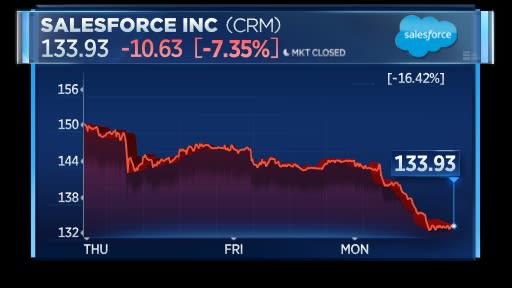
CRM ended Monday down nearly 1% at $192.95, marking a second straight session of losses. That two-day slide matters less than why buyers are hesitant. Investors aren’t just reacting to a single quarter; they’re pricing a transition period where Salesforce is trying to defend its core franchise while selling Wall Street on its next act: Agentforce, automation, and an “AI-first” platform story that must compete not only with traditional rivals, but also with newer AI-native tools.
Why the First Target Hike Didn’t Move the Stock
Citi raised its price target on Salesforce to $200 from $197 and maintained a Neutral rating. On paper, that implies about 4% upside from current levels. In a calm market, a “first hike after the scare” might read like an all-clear signal. In this market, it reads more like a cautious housekeeping update: Citi refreshed its model post-earnings, nudged the target higher, but did not upgrade the rating.
That distinction is important. A target hike with a Neutral tag is basically Citi saying: “We see a little more value than last week, but not enough conviction to call this a compelling risk-reward.” And when Salesforce is sitting at the center of the “AI disrupts software” debate, neutrality can feel like a cold shower.
The stock’s premarket dip also reflects how investors currently treat incremental good news: they demand confirmation from multiple angles—guidance, bookings, product momentum, and competitive differentiation—before they pay up. With software stocks having been hit by fears of AI-driven disruption, traders are no longer satisfied with beats and buybacks alone. They want proof that growth can re-accelerate without sacrificing margins, and that AI is additive rather than cannibalistic.
Wall Street Cuts Targets, Keeps AI Faith (Mostly)
Aside from Citi’s small bump, the broader pattern across the Street was target cuts after the fiscal 2027 outlook came in softer than many hoped. Importantly, several banks kept bullish ratings while trimming targets—meaning they still like Salesforce long term, but are less willing to underwrite a near-term rerating until the company clears a higher bar on execution.
Here’s the tone from key firms:
Goldman Sachs: The Agentforce “Durability” Test
Goldman lowered its target to $281 from $330 while maintaining a Buy rating, framing the big question as whether Salesforce can turn Agentforce into durable growth versus newer competitors. That’s a polite way of saying: “Show us this is not just a nice product—show us it becomes an enduring growth engine.”
Piper Sandler: “Is AI Eating SaaS?”
Piper kept Overweight but cut its target to $250, calling out that guidance implying 10.5% growth is “likely not changing minds” as investors question whether AI is eating software-as-a-service. This is the core anxiety across the sector: if AI tools reduce seat counts, simplify workflows, or replace some functions, then subscription growth could slow structurally.
Wedbush: Long-Term Winner, Short-Term Pain
Wedbush reiterated Outperform while trimming its target to $325. The firm still sees Salesforce as a long-term AI winner, but called it near the “epicenter” of an AI-driven selloff in software. Translation: even if Salesforce wins the AI race, the market may still punish the category while it figures out how the revenue model evolves.
JPMorgan: “Static” Quarter, Better Internals
JPMorgan kept Overweight and described the quarter as “static,” while noting internal metrics are improving. This is another recurring theme: the operational signals may be trending in the right direction, but the market is hesitant to celebrate until those signals show up clearly in revenue acceleration.
More Cautious Takes: “Fully Valued” and “Deceleration”
RBC cut its target to $210, kept Sector Perform, and said shares look fully valued. Bernstein held an Underperform stance and pointed to guidance implying slight organic growth deceleration.
The list of other firms trimming targets was long—Truist, D.A. Davidson, Baird, BMO, Mizuho, TD Cowen, Canaccord, Oppenheimer, BTIG, Stifel, Roth Capital, Wells Fargo, Barclays, and others. When that many institutions move targets lower at once, it creates a psychological ceiling. Even if the stock is fundamentally fine, flows and positioning tend to stay defensive until the next catalyst forces a rethink. if lawmakers want to reduce systemic risk while still allowing innovation.tting-edge relationships via effective experiences. Collaboratively engage plug-and-play resources and competitive.
The Real Debate: AI as Growth Engine or SaaS Margin Squeeze?
Salesforce is now a proxy for a bigger market argument. Bulls say: AI expands Salesforce’s product value, increases automation, and drives new modules and higher wallet share. Bears say: AI lowers friction, compresses pricing power, and makes it easier for customers to consolidate tools or demand fewer licenses.
What makes this debate sharper for Salesforce is its scale. When you’re a category leader, the market expects you to both innovate and protect a massive installed base. That’s harder than it sounds. It’s one thing to launch AI features; it’s another to prove they create incremental revenue without weakening the underlying subscription model.
The result is a “show-me” environment where investors are hypersensitive to guidance and forward-looking commentary. In that context, even a strong quarter can be overshadowed by cautious revenue outlooks.
What Salesforce Actually Reported: The Quarter Was Strong
If you just looked at the reported Q4 numbers, you could reasonably ask: why is everyone so nervous?
Salesforce posted Q4 EPS of $3.81, beating estimates of $3.05, on revenue of $11.2 billion. The company also showed strength in backlog-type measures: current remaining performance obligations (RPO) rose 16% year over year to $35.1 billion, and total RPO climbed 14% to $72 billion.
Those are not weak numbers. They suggest enterprise spending isn’t collapsing, and Salesforce still has meaningful contracted business. The issue is not whether Salesforce is “broken.” The issue is whether Salesforce can accelerate growth in a world where AI is changing buyer expectations, procurement behavior, and software workflows.
Agentforce: Momentum Is Rising, But the Market Wants Proof
CEO Marc Benioff called it a “phenomenal quarter” and reiterated confidence in the company’s long-term trajectory, including a goal of $63 billion in annual revenue by fiscal 2030. The most watched AI datapoint was Agentforce’s annual recurring revenue, which climbed to $800 million from $500 million in the prior quarter. Salesforce also cited record bookings and 29,000 deals closed.
That’s meaningful momentum. Still, investors will ask the uncomfortable follow-ups:
- How much of that ARR is truly incremental versus bundled, discounted, or re-labeled spend?
- How repeatable are those bookings at scale?
- Will Agentforce deals expand over time, or flatten after initial adoption?
- How does Salesforce defend differentiation as AI-native competitors move fast?
Salesforce also reiterated expectations for “organic growth re-acceleration” in the second half of fiscal 2027. That statement is a bridge—investors must cross it on faith until they see evidence. And right now, faith is expensive.
Buybacks, Dividends, and M&A: Salesforce Flexes Capital Return
Salesforce authorized a new $50 billion share repurchase program and raised its quarterly dividend by 5.8% to $0.44 per share. It also signaled continued acquisitions and described the balance sheet as “very underleveraged.”
This is Salesforce making a direct pitch to investors: “We can invest in AI and still return capital aggressively.” Buybacks can support a floor under the stock, especially during periods of uncertainty. But they don’t fix growth concerns by themselves. A buyback is a confidence signal; the market still wants a growth proof point.
Meanwhile, the mention of continued acquisitions can cut both ways. Deals can accelerate product capability and fill gaps, but they can also raise integration risk and create questions about whether internal innovation is enough.
Retail Reaction: Optimism Collides With Skepticism
On Stocktwits, retail sentiment for CRM was extremely bullish with extremely high message volume. That’s a notable contrast with the price action, and it speaks to how different cohorts interpret the same facts.
One bullish user argued that buybacks “ensure the floor” and that it’s “only upwards from here,” framing Salesforce as a slow, steady compounder that will keep retiring shares while the stock is cheap.
Another user pointed to the bigger macro concern: even if AI doesn’t “disrupt” SaaS overnight, productivity gains could translate into fewer licenses over time. That’s the core bear case expressed in plain language: if companies need fewer seats to do the same work, subscription revenue growth faces headwinds.
The Setup From Here: What Investors Will Watch Next
With CRM down 27% year-to-date, the stock is already reflecting a meaningful re-pricing. But the market is signaling that the next move won’t be driven by one brokerage changing a target from $197 to $200. It will be driven by whether Salesforce can deliver clarity on three fronts:
- Guidance credibility: can the company show a path to re-acceleration without moving goalposts?
- AI monetization: can Agentforce become a scaled revenue engine, not a headline?
- Moat strength: can Salesforce defend enterprise workflows as AI tools multiply?
Until those answers get sharper, target hikes may remain “nice, but not enough.” The stock can still rally on execution, but the market’s default posture is cautious—and it’s going to take more than a modest target bump to wake up the bulls.