

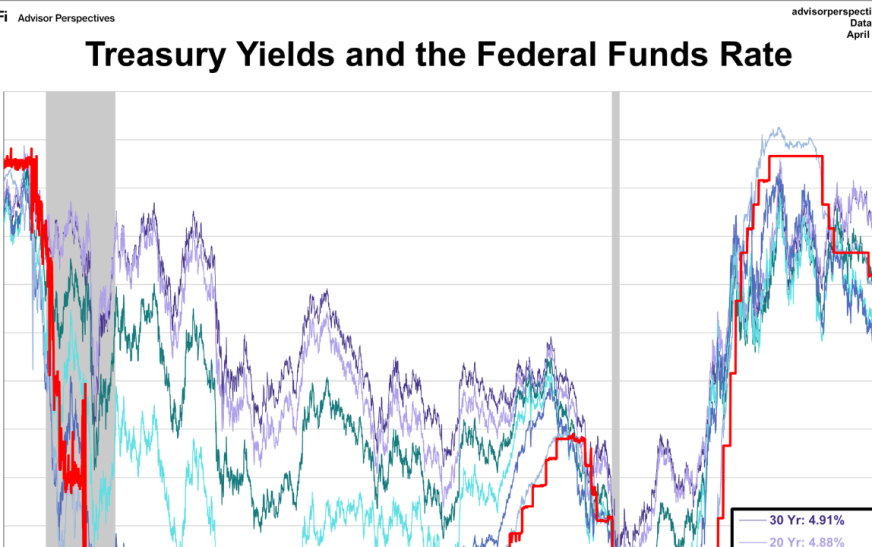
Treasury yields climb as markets await the Fed
Treasury yields moved higher ahead of the Federal Reserve’s upcoming interest-rate decision, as investors weighed inflation risks, a resilient U.S. consumer and uncertainty around the final Fed meeting expected to be chaired by Jerome Powell. The move also came alongside a firmer U.S. dollar, showing that markets remain cautious before one of the week’s most important policy events.
According to the original Dow Jones Market Talk report via TradingView, the 10-year Treasury yield rose 0.017 percentage point to 4.352%, while the two-year yield increased 0.040 percentage point to 3.843%. The Federal Reserve is expected to keep interest rates unchanged, but traders are focused on guidance for the months ahead.
This is a familiar but important market setup. When investors already know the likely rate decision, the statement and press conference become more important than the decision itself. The question is not whether the Fed will hold rates. The question is how policymakers will describe inflation, oil prices, consumer strength and the future path of monetary policy.
The bond market is also watching Powell’s personal role. This is expected to be his last Fed meeting as chairman, and investors may look for clues about whether he plans to remain on the interest-rate-setting body after his chairmanship ends.
Why Treasury yields are rising
Treasury yields are rising because investors are reassessing the balance between inflation risk and policy stability. The Fed is expected to leave rates unchanged, but inflation remains a concern as the conflict in Iran pushes oil prices higher.
Higher oil prices can complicate the inflation outlook. They can raise gasoline, diesel, transport and production costs. Even if core inflation is not immediately affected, energy shocks can influence consumer expectations and business pricing decisions.
That matters for Treasury yields because bond investors demand compensation for inflation risk. If inflation looks more persistent, yields often rise. If the Fed appears less likely to cut rates or shift toward easier policy, short-term and medium-term yields can also move higher.
The two-year Treasury yield is especially sensitive to Fed policy expectations. Its rise to 3.843% suggests that traders are not expecting a rapid shift toward easier policy. The 10-year yield at 4.352% reflects broader expectations around inflation, growth, government borrowing and long-term rates.
For investors following major policy events and market reactions, Finprozone’s latest market news provides broader coverage across global financial categories.
The Fed is expected to hold rates steady
The Fed is widely expected to keep rates on hold. That part of the story is not controversial. Markets have largely priced in no immediate change.
However, a steady rate decision does not mean the meeting is unimportant. The Fed’s communication can still move Treasury yields, the U.S. dollar, equities, commodities and crypto.
Investors will want to know whether policymakers see inflation as contained or still problematic. They will also watch whether the Fed acknowledges the impact of higher oil prices linked to the Iran conflict. If Powell sounds concerned about inflation, yields could remain elevated. If he sounds more confident that inflation is under control, bond yields may stabilize.
The Fed’s guidance for the second half of the year will be especially important. Markets want to know whether rate cuts remain possible, whether rates may stay higher for longer or whether the central bank is waiting for more data before signaling any shift.
In this environment, even small wording changes can have a large market impact.
Inflation remains the central concern
Inflation remains the main pressure point for the bond market. The U.S. economy continues to show resilience, while oil prices are rising because of geopolitical disruption. That combination makes it harder for the Fed to sound clearly dovish.
The latest report noted that April’s Conference Board consumer confidence gauge unexpectedly increased. That suggests the U.S. consumer remains stronger than expected. March durable goods orders are also expected to rise, reinforcing the idea that economic demand has not weakened sharply.
Strong consumer and business data can support growth, but it also complicates the inflation picture. If demand remains firm while oil prices rise, the Fed may be reluctant to ease policy too soon.
Bond traders are highly sensitive to this balance. If the economy weakens, yields can fall as investors expect rate cuts. If the economy stays resilient and inflation risk persists, yields can rise because the Fed may need to keep policy tighter.
That is the current tension. Growth is not weak enough to force a dovish pivot, and inflation is not calm enough to give policymakers complete comfort.
Oil prices add pressure to the Fed outlook
The Iran conflict has pushed oil prices higher, increasing inflation anxiety before the Fed decision. This matters because energy prices affect both markets and consumers quickly.
Higher oil prices can raise household fuel costs. They can also raise costs for airlines, shipping firms, manufacturers, retailers and food producers. If businesses pass those costs on, inflation pressure can spread.
For Treasury markets, oil creates a policy dilemma. If higher energy prices slow growth, yields could eventually fall. But if energy prices keep inflation elevated, yields can rise because the Fed may stay restrictive.
Right now, the market appears more focused on the inflation side of the equation. That is why Treasury yields and the dollar moved higher ahead of the Fed meeting.
The Fed may not react to every oil move immediately, but it cannot ignore a sustained energy shock. Powell’s comments on whether oil prices are likely to create broader inflation risk will be closely watched.
The dollar strengthens with yields
The U.S. dollar rose alongside Treasury yields, which is a common market reaction when investors expect U.S. rates to remain relatively attractive. Higher yields can support the dollar because they increase returns on dollar-denominated assets.
A stronger dollar can also reflect caution. When global uncertainty rises, investors often move toward dollar liquidity. In the current environment, both factors may be supporting the currency: higher yields and geopolitical risk.
This matters because dollar strength can ripple across asset classes. It can pressure commodities, emerging-market currencies, international equities and crypto. It can also tighten global financial conditions by making dollar borrowing more expensive outside the United States.
For the Fed, a stronger dollar may help contain import inflation, but it can also affect corporate earnings and global demand. For investors, the dollar’s direction remains an important signal of market confidence.
If yields continue rising and the dollar strengthens further after the Fed decision, risk assets may face additional pressure. If Powell softens the market’s rate expectations, the dollar could lose some momentum.
Powell’s future role adds unusual uncertainty
This Fed meeting carries an unusual layer of institutional uncertainty because it is expected to be Jerome Powell’s last as chairman. Investors will watch whether he gives any signal about remaining on the Board of Governors after his chairmanship ends.
That issue may seem separate from Treasury yields, but leadership continuity matters for markets. The Fed’s credibility depends partly on institutional stability and policy independence. If investors see uncertainty around governance or the future direction of the central bank, they may demand higher risk premiums.
Powell may avoid giving a direct answer. According to commentary cited in the report, RSM chief economist Joe Brusuelas suggested Powell may wait for a Supreme Court decision involving the administration’s efforts to remove Fed Governor Lisa Cook from office for cause.
Powell previously described that legal matter as potentially one of the most important cases in the Fed’s history. That signals how seriously markets may treat questions around central bank independence.
For bond investors, the main issue is whether the Fed remains predictable, independent and credible. Any perceived threat to those qualities can affect yields.
Bond markets are watching supply and demand too
While the Fed remains important, some fixed-income managers argue that the market has changed. David Kang of Ducenta Squared said the Fed announcement has lost some relevance for fixed-income markets because bond supply and demand dynamics have become more important.
This is a crucial point. Treasury yields are not driven only by Fed policy. They are also affected by the supply of government debt, corporate bond issuance and consumer debt securities.
When there is more debt supply, investors need to absorb more bonds. If demand does not keep pace, yields may rise to attract buyers. This is one reason Treasury yields can remain elevated even when markets expect the Fed to hold rates steady.
The U.S. government’s borrowing needs, corporate financing activity and household credit trends all influence fixed-income markets. The Fed sets short-term rates, but the market sets longer-term yields through supply, demand and inflation expectations.
This makes the current Treasury yield environment more complex than a simple Fed-watch story.
Corporate and consumer debt change the fixed-income landscape
The report also highlighted that corporations are using technology to strengthen balance sheets, leading fixed-income managers to reassess yields across sovereign bonds, corporate bonds and consumer debt.
This reflects a broader shift in the bond market. Investors are not only choosing between Treasury bills and Treasury notes. They are allocating across many credit instruments with different risk profiles, maturities and yields.
If corporate bonds offer attractive compensation, some investors may shift away from Treasuries. If consumer debt securities offer better risk-adjusted returns, allocations may change again. These flows can influence Treasury demand.
This is why bond managers are increasingly focused on relative value. They compare Treasury yields against corporate credit, securitized debt, consumer credit and global sovereign bonds.
The Fed still matters. But in a market with large and diverse debt supply, the central bank is only one part of the yield story.
Bitcoin ETFs and risk assets show caution
The same report also noted that bitcoin spot ETFs ended a two-week streak of positive net inflows, with $263.2 million in net outflows recorded on Monday, according to CoinGlass data. Bitcoin was trading lower near the $76,000 area.
This is relevant because it shows that risk assets are also cautious ahead of the Fed decision. When Treasury yields rise, speculative assets can face pressure. Higher yields increase the opportunity cost of holding non-yielding or high-volatility assets.
Bitcoin’s weakness does not directly drive Treasury yields, but it fits the broader market tone. Investors appear to be reducing risk exposure while waiting for policy guidance.
This is also visible in short positioning. Some investors are reportedly still betting against bitcoin despite recent gains, while others are accumulating aggressively. That split suggests markets are preparing for potential volatility after the Fed decision.
The same dynamic can apply across equities, commodities and currencies. When a major central bank event approaches, positioning often becomes more defensive.
What Treasury investors should watch next
Treasury investors should watch several key signals.
The first is Powell’s inflation language. If he emphasizes oil-driven inflation risk, yields may remain supported. If he suggests the Fed can look through temporary energy shocks, yields may stabilize.
The second is guidance for the second half of the year. Markets want to know whether rate cuts remain plausible or whether policy will stay restrictive.
The third is the two-year yield. Because it is sensitive to Fed expectations, it can quickly reflect changes in market pricing.
The fourth is the 10-year yield. This rate reflects broader views on inflation, growth, debt supply and long-term policy credibility.
The fifth is the dollar. If the dollar continues rising with yields, it may signal tighter global financial conditions.
To track upcoming central bank decisions and economic releases, readers can use Finprozone’s economic calendar for upcoming market events.
Conclusion
Treasury yields rose ahead of the Federal Reserve decision as investors weighed inflation risks, higher oil prices, resilient consumer data and uncertainty around Jerome Powell’s final expected meeting as Fed chairman. The 10-year yield increased to 4.352%, while the two-year yield climbed to 3.843%.
The Fed is expected to keep rates unchanged, but markets are focused on Powell’s guidance. Inflation remains a concern as the Iran conflict pushes oil prices higher. At the same time, stronger consumer confidence and expected growth in durable goods orders suggest the economy remains resilient.
Bond investors are also paying attention to broader fixed-income supply and demand. Rising government, corporate and consumer debt issuance means Treasury yields are shaped by more than Fed policy alone.
The next move in yields will depend on whether Powell sounds concerned about inflation, whether the Fed keeps rate-cut hopes alive and whether markets continue demanding higher compensation for holding bonds. Until those questions are answered, Treasury markets are likely to remain sensitive to every policy signal.
FAQ
Why are Treasury yields rising before the Fed decision?
Treasury yields are rising because investors remain concerned about inflation, higher oil prices and the future path of Fed policy. Stronger consumer confidence also suggests the economy may be resilient enough for rates to stay elevated.
What is the Fed expected to do?
The Federal Reserve is expected to keep interest rates unchanged. Markets are focused less on the rate decision itself and more on Jerome Powell’s comments about inflation, oil prices and future monetary policy.
Why does the two-year Treasury yield matter?
The two-year Treasury yield is highly sensitive to Fed policy expectations. When it rises, it often suggests traders expect interest rates to stay higher for longer or that rate cuts may be delayed.
How do oil prices affect Treasury yields?
Higher oil prices can increase inflation expectations. If investors believe energy costs will keep inflation elevated, they may demand higher yields on Treasuries, especially if the Fed is expected to remain cautious.
What should bond investors watch next?
Bond investors should watch Powell’s guidance, inflation language, oil prices, the U.S. dollar and Treasury auction demand. These factors will help determine whether yields continue rising or stabilize after the Fed decision.










1 Comment
[…] yen is vulnerable when U.S. rate expectations rise. Higher U.S. yields make the dollar more attractive, while the yen often struggles when Japan’s interest-rate […]
Comments are closed.