Consumer discretionary stocks are facing renewed pressure as high gasoline prices weigh on household budgets, reduce store traffic, and make investors more cautious toward retail, travel, apparel, and leisure names. According to the original Barron’s report published through TradingView, gas prices are holding near $4.50 a gallon, creating a clear headwind for discretionary spending while Wall Street analysts continue to argue that the U.S. consumer should not be counted out.
The concern is straightforward. When fuel costs rise, consumers have less money left for non-essential purchases. Higher gasoline prices can affect shopping trips, dining out, travel, apparel purchases, home improvement spending, and other discretionary categories. That pressure is especially important in a K-shaped economy, where higher-income households keep spending while lower- and middle-income consumers become more selective.
Even so, analysts remain divided between short-term caution and longer-term resilience. The Consumer Discretionary Select Sector SPDR ETF is near all-time highs, but much of that strength comes from two dominant holdings: Tesla and Amazon.com. According to the report, those two companies account for about 45% of the fund, raising concerns about narrow sector breadth.
That means the consumer discretionary sector is not simply strong or weak. It is uneven. Some companies remain highly valued and well-supported, while others are more exposed to fuel prices, weaker store traffic, and pressure on lower-income consumers.
Why Gas Prices Matter for Consumer Discretionary Stocks
Gas prices matter because they act like a direct tax on household spending. When consumers pay more at the pump, they have less flexibility for purchases that can be delayed, reduced, or avoided. This makes fuel inflation especially relevant for consumer discretionary stocks.
Unlike staples, discretionary categories depend more on confidence and disposable income. People still need groceries, medicine, and basic household goods when prices rise. They may delay buying apparel, electronics, hotel stays, restaurant meals, or new vehicles if fuel costs squeeze budgets.
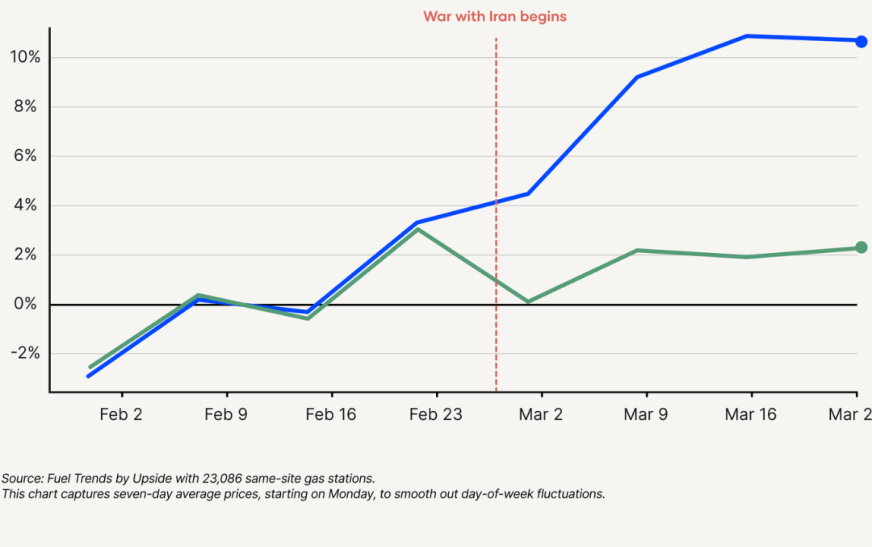
The Barron’s report notes that the national average gasoline price stands at $4.49, according to AAA, while oil prices are up 83% year to date through Friday’s close. That scale of energy inflation can change consumer behavior quickly.
High gasoline prices can also reduce physical shopping activity. If shoppers drive less, retailers may see weaker store traffic. This can pressure companies that rely heavily on in-person visits, especially if they do not have strong online channels or loyal high-income customers.
For investors, the key issue is whether fuel prices remain elevated long enough to reduce earnings estimates. If gas prices fall, discretionary stocks may rebound. If fuel costs stay high, margin and revenue pressure may become more visible.
Sector Strength Is Narrowly Concentrated
One reason the discretionary sector looks stronger than many investors might expect is index concentration. The Consumer Discretionary Select Sector SPDR ETF is near all-time highs, but Tesla and Amazon account for about 45% of the fund.
That creates a breadth problem. A sector can appear strong because a few mega-cap names are holding up or rising, even while many underlying companies face more difficult conditions. Ed Yardeni of Yardeni Research described the sector as one to hold rather than chase, noting that a strong index resting on two stocks, with thin breadth and a full multiple, requires discipline.
This is an important point for investors. Buying the sector ETF is not the same as buying an equal basket of retailers, apparel names, auto parts companies, hotels, restaurants, and consumer services. The fund’s performance may be driven heavily by Amazon and Tesla rather than broad consumer strength.
That does not make the sector unattractive. It means investors need to understand what they own. A market-cap-weighted discretionary fund may behave differently from the average discretionary stock.
The K-Shaped Economy Shapes the Sector
The consumer discretionary sector is directly exposed to the K-shaped economy. In this environment, wealthier households continue spending, while lower- and middle-income consumers pull back. That creates a split market.
Companies serving high-income consumers may remain resilient. Premium travel, high-end retail, select hotels, and certain online platforms may benefit from customers who are less sensitive to fuel costs. Companies relying on budget-conscious consumers may face more pressure.
This split helps explain why some well-known companies continue trading at rich valuations even as broader consumer sentiment looks mixed. Walmart, Costco, TJX, O’Reilly Automotive, and Hilton were mentioned in the report as industry winners that still trade at elevated valuations, even after pulling back from recent highs.
Carey Kaufman of Jefferies argued that these companies may simply need a breather rather than a severe reset. That distinction matters. A good business with a high valuation can underperform temporarily without becoming a broken story.
Still, investors should be careful. In a K-shaped economy, stock selection becomes more important than broad sector exposure. The strongest companies may remain resilient, while weaker consumer names could face sharper volatility.
For broader updates on retail, earnings, consumer trends, and market sentiment, Finprozone latest market news provides regular coverage of developments shaping sector performance.
Margins Remain a Key Concern
Consumer discretionary stocks also face a margin challenge. The report notes that forward profit margins for the sector are the third-lowest among the 11 major sectors. That matters because companies with thinner margins have less room to absorb cost pressure.
Higher fuel prices can affect margins in several ways. Transportation costs may rise. Suppliers may pass through higher expenses. Consumers may resist price increases. Promotional activity may increase if demand slows. Labor costs may remain elevated. All of this can pressure profitability.
For retailers and consumer brands, pricing power becomes crucial. Companies that can raise prices without losing customers may protect margins. Companies that must discount to maintain sales may struggle.
This is why analysts are watching pricing power closely. Morgan Stanley’s Michael Wilson pointed to improvements in pricing power as one catalyst that could help the sector. If companies can maintain prices while demand remains stable, the sector’s earnings outlook may improve.
However, pricing power is not evenly distributed. Strong brands, premium operators, and essential-adjacent retailers may have more flexibility. Weaker brands may need to sacrifice margin to protect traffic.
Earnings Growth Could Improve in 2026
Despite the fuel-price headwind, the earnings outlook is not entirely negative. Yardeni noted that earnings growth for the discretionary sector is expected to nearly double to 14.6% in 2026. That is a meaningful number, especially if the sector can deliver it while facing high oil prices.
The valuation picture also changes when Amazon and Tesla are stripped out. According to the report, excluding those two names leaves the discretionary sector’s valuation closer to the middle of its historical range. That suggests the broader sector may not be as expensive as the headline ETF valuation implies.
This is important because investors often look at sector-level multiples and assume everything inside the sector is expensive. In reality, concentration can distort the picture. Some stocks may be fully valued, while others may offer more reasonable entry points if earnings trends improve.
Still, earnings growth needs confirmation. With earnings season mostly complete, there may be limited near-term catalysts until companies begin speaking again at conferences and executive commentary windows reopen. That creates a quiet period where macro headlines, oil prices, and consumer data may dominate.
Oil Prices Are the Main Short-Term Catalyst
The biggest near-term catalyst for discretionary stocks is oil. If oil prices fall because the Middle East war ends or the Strait reopens, discretionary stocks could briefly outperform, according to Yardeni.
That makes sense. Lower oil prices would reduce pressure on gasoline, ease household budget stress, and improve sentiment toward consumer-facing stocks. It could also reduce inflation concerns, helping the broader market.
Morgan Stanley’s Michael Wilson made a similar point. He argued that the oil shock has held discretionary stocks back, but pressure could begin to ease if the Strait reopens, even partially, because risk is already priced into the area.
This means investors should watch energy markets closely. The discretionary sector may not need perfect consumer data to recover. It may simply need relief from fuel inflation.
However, if oil prices remain elevated, the sector may continue to trade unevenly. Strong companies may hold up, but weaker names could struggle.
Goods Spending Could Support the Sector
Another potential catalyst is a shift back toward goods spending. During some parts of the post-pandemic cycle, consumers prioritized services such as travel, restaurants, entertainment, and experiences. If spending rotates back toward goods, certain retailers, apparel names, home-related companies, and durable goods businesses could benefit.
Wilson cited this shift back toward goods over services as one reason to keep paying attention to the sector. He also pointed to improving earnings revisions breadth, especially in durables and apparel, where revisions have recently improved.
That could be relevant for companies such as Gap and Abercrombie & Fitch, which were scheduled to report this week, according to the source. If apparel companies show better-than-expected sales, margins, or guidance, it may support the idea that discretionary demand is not as weak as gasoline prices suggest.
The goods-spending story is important because consumer behavior changes over time. Higher fuel costs may reduce some spending, but consumers may still prioritize categories that offer value, style, replacement demand, or emotional satisfaction.
The Consumer Has Not Entered Full Austerity
A key argument from analysts is that U.S. consumers rarely enter true austerity unless multiple shocks occur at once. Carey Kaufman of Jefferies noted that the only time he saw actual mass austerity by the U.S. consumer was during the Great Financial Crisis, when real estate, equities, and consumer credit all tightened severely.
That historical comparison matters. Today’s environment is difficult, but it is not the same as a full credit and asset-price collapse. Gas prices are high, inflation is painful, and some households are under pressure. But employment remains resilient, high-income consumers continue spending, and corporate earnings have not broadly collapsed.
This is why analysts are reluctant to give up on discretionary stocks entirely. The consumer may be pressured, but not broken. The sector may be out of favor, but not necessarily uninvestable.
The risk is that pressure accumulates. If gasoline prices stay high, credit conditions tighten, hiring slows, and savings weaken, discretionary spending could soften more sharply. Investors should therefore monitor the consumer carefully rather than assume resilience will last automatically.
Retail Therapy Remains a Market Force
The Barron’s report closes with the idea that retail therapy remains popular even when times are tough. That is more than a clever phrase. It reflects an important behavioral reality: consumers may cut back in some areas but continue spending in categories that offer emotional value, convenience, status, or perceived necessity.
This is why the discretionary sector can surprise investors. A pressured consumer does not stop spending completely. Instead, spending shifts. Some categories lose share. Others gain. Value retailers, off-price chains, e-commerce platforms, auto parts retailers, hotels, and selected apparel brands may each experience different outcomes.
For investors, this means broad consumer weakness does not automatically apply to every stock. The better approach is to look at customer base, pricing power, brand strength, cost structure, valuation, and earnings revisions.
The consumer discretionary sector is complex because it includes both high-growth giants and cyclical retailers. That complexity creates risk, but also opportunity.
What Investors Should Watch Next
The first factor to watch is gasoline prices. If the national average moves lower from around $4.49, consumer sentiment may improve and discretionary stocks could get relief.
The second factor is oil market developments, especially any progress tied to the Middle East conflict and the Strait. Energy relief would be a direct positive for the sector.
The third factor is earnings revisions. Morgan Stanley noted improving revisions breadth in discretionary, durables, and apparel. Continued improvement would support the bullish case.
The fourth factor is company commentary at upcoming conferences. With earnings season mostly complete, executive updates may be important for demand and margin expectations.
The fifth factor is sector breadth. Investors should watch whether gains extend beyond Amazon and Tesla. Broader participation would make the sector’s strength more convincing.
Consumer Discretionary Stocks Remain Selective, Not Simple
Consumer discretionary stocks are not an obvious chase, but they are not a clear avoid either. High gasoline prices are a real headwind, and sector breadth is narrow. Margins are relatively weak compared with other sectors, and valuations remain elevated for several high-quality winners.
At the same time, the U.S. consumer has shown resilience, earnings growth expectations remain constructive, and some analysts see catalysts from goods spending, pricing power, high-income consumer demand, and potential oil-price relief.
The best conclusion is that selectivity matters. Investors may need to separate concentrated ETF performance from the broader sector, and strong operators from weaker consumer names. A pullback in quality companies may create opportunities, but high valuations and fuel-price risk argue against chasing indiscriminately.
FAQ
Why are gas prices hurting consumer discretionary stocks?
High gas prices reduce disposable income and can keep shoppers away from stores. When consumers spend more on fuel, they may cut back on apparel, travel, restaurants, home goods, and other non-essential purchases, which pressures discretionary companies.
Is the consumer discretionary sector still strong?
The sector looks strong at the index level, but much of that strength is concentrated in Amazon and Tesla. Investors should watch whether performance broadens across retailers, apparel companies, hotels, and other consumer names before calling the sector broadly healthy.
Why do analysts still trust the U.S. consumer?
Analysts point to resilient spending, high-income consumer strength, improving earnings revisions, and the absence of a broad austerity shock. Consumers are pressured by fuel prices, but many companies continue reporting stable sales and better-than-expected earnings trends.
Which catalysts could help discretionary stocks?
Lower oil prices, better gasoline affordability, stronger goods spending, improving pricing power, and positive earnings revisions could all support discretionary stocks. Company updates at upcoming conferences may also help reset investor expectations.
How should investors analyze consumer discretionary stocks now?
Investors should compare valuation, margins, customer base, pricing power, earnings revisions, and fuel sensitivity. For deeper sector tracking and market comparison, use market tools and trading resources to follow consumer stocks and related catalysts.