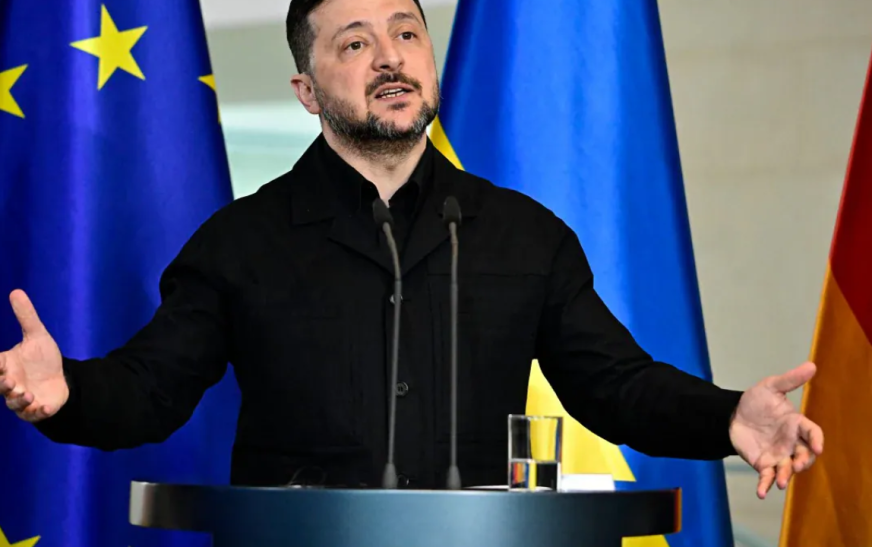
Ukraine’s peace talks have entered a more dangerous and politically explosive phase after President Volodymyr Zelenskiy said the United States is making high-level security guarantees conditional on Kyiv giving up the Donbas region to Russia. In an interview with Reuters, Zelenskiy said Washington was prepared to finalize the guarantees once Ukraine was ready to withdraw from Donbas, a position he described as deeply problematic for Ukraine’s long-term defense and, by extension, for Europe’s security.
The significance of that statement goes far beyond another difficult negotiating point. It suggests the central bargain now being pushed at the highest level is not just peace in exchange for territory, but security in exchange for territory. That is a much sharper and more consequential formulation. For Ukraine, it raises the question of whether a postwar guarantee is really a guarantee at all if it depends on surrendering the very defensive positions Kyiv believes are essential to preventing future Russian aggression. For Europe, it raises a parallel concern: whether a peace deal structured this way would stabilize the continent or merely freeze the war on terms that leave Russia better positioned for the next round.
Zelenskiy’s comments also arrive at a moment when Washington’s attention is increasingly split by its own war with Iran. According to him, that shift matters. He argued that President Donald Trump, preoccupied by events in the Middle East, is still choosing a strategy of putting more pressure on Ukraine than on Russia in order to secure a rapid settlement.
A peace proposal built around territorial sacrifice
The heart of Zelenskiy’s concern is straightforward. Ukraine has repeatedly said that security guarantees are essential to any peace agreement because Kyiv does not believe Russia would necessarily stop permanently just because a deal is signed. In that context, the nature of the guarantee matters as much as the existence of one.
According to Zelenskiy, the U.S. position now being discussed would effectively make those guarantees contingent on Ukraine abandoning Donbas. He said he understood the “subtleties” of the American position, even though he was not personally participating directly in the trilateral negotiations. That phrasing matters. It suggests Kyiv sees the offer not as a misunderstanding or rumor, but as a real element of the negotiating framework.
This is especially sensitive because Donbas is not just symbolic territory in the Ukrainian view. It includes heavily fortified defensive lines and urban belts that military analysts have long described as strategically significant. Zelenskiy warned that a withdrawal would not merely mean a political concession. It would compromise Ukraine’s security by handing strong defensive positions to Russia. He put it bluntly: eastern Ukraine is part of Ukraine’s security guarantees.
That argument gets to the core of why this issue is so difficult. A territorial concession can sometimes be framed diplomatically as a painful compromise for peace. But when the territory in question is also a defense structure, the concession changes meaning. It is no longer just about borders on a map. It becomes about future military geometry.
Why Donbas remains central to Moscow’s war aims
The dispute is even more dangerous because Russia has never hidden how important Donbas is to its own objectives. Reuters noted that President Vladimir Putin continues to insist that full control of Donbas is an essential part of Russia’s war aims and that Moscow would seek to achieve that on the battlefield if it could not secure it at the negotiating table.
That position gives the negotiations an especially hard edge. If Washington is indeed linking guarantees to a Ukrainian withdrawal, then the United States would be pressing Kyiv toward a concession that Moscow already considers central to victory. From a Ukrainian perspective, that risks turning a security package into a mechanism for formalizing a battlefield objective Russia has struggled to fully achieve by force.
And Russia has struggled. Zelenskiy pointed out that Moscow’s advance has been slow. Analysts have also argued that taking the remaining parts of Donbas would require time, manpower, and sustained pressure against heavily fortified positions. That is one reason Zelenskiy openly questioned whether Russia is actually willing to spend hundreds of thousands more soldiers trying to seize the roughly 6,000 square kilometers of Donbas it does not already control.
This makes the current moment especially consequential. If the battlefield path remains costly for Russia, then negotiations become more valuable to Moscow. If negotiations can produce what military operations have not yet fully delivered, then the structure of the deal matters enormously.
Security guarantees remain vague where Kyiv wants clarity
Zelenskiy’s criticism is not limited to the Donbas condition itself. He also emphasized that two major questions on security guarantees remain unresolved.
The first is funding: who would help finance Ukraine’s weapons purchases in the future so that the country could maintain a credible deterrent after any ceasefire or settlement. The second is response: what exactly allies would do if Russia attacked again.
These are not technical side issues. They define whether a guarantee is real or rhetorical.
Ukraine’s position has long been shaped by painful experience. Kyiv has learned that broad political assurances are not enough if they are not backed by military capability, supply continuity, and a credible commitment mechanism. A guarantee without a funding path risks becoming symbolic. A guarantee without a response framework risks becoming ambiguous. And ambiguity is precisely what Ukraine fears Russia could exploit in the future.
That is why Zelenskiy’s comments feel so sharp. He is not merely saying the U.S. proposal asks too much territorially. He is also implying that the package still lacks the operational clarity that would make any sacrifice easier to justify.
Trump’s Iran focus is reshaping the Ukraine file
One of the most striking aspects of the interview is Zelenskiy’s suggestion that the Middle East war is influencing Trump’s choices on Ukraine. He said the conflict with Iran “definitely” affects Trump and his next steps, and argued that the U.S. president is choosing to apply more pressure to Ukraine in pursuit of a fast outcome.
That reading fits a broader strategic concern in Kyiv: that Washington’s bandwidth is finite and that the longer Ukraine peace talks stall, the greater the risk that American attention drifts. Zelenskiy said Russia is effectively betting that the United States will lose interest if negotiations drag and will eventually walk away. He acknowledged there is at least some risk of that.
That concern has become more concrete because a fourth round of trilateral talks expected this month was postponed due to the Iran conflict. In other words, the Middle East war is no longer just background distraction. It is directly affecting the rhythm of diplomacy on Ukraine.
This matters politically as well as militarily. If Ukraine believes Washington is in a hurry because it wants to reduce one major geopolitical burden while fighting another, then pressure from the U.S. side may increasingly feel less like alliance management and more like timetable management.
Zelenskiy is trying to separate military cooperation from political pressure
Despite those tensions, Zelenskiy also took care to thank Trump for continuing U.S. weapons deliveries, especially Patriot air defense missiles. That portion of the interview was important because it shows Kyiv is trying to distinguish between frustration over peace pressure and appreciation for continued battlefield support.
Ukraine had worried that Patriot deliveries might slow or stop because of increased demand generated by the Gulf conflict. Zelenskiy said supplies had not been cut off and expressed gratitude to Trump and his team, while also stressing that the volume remains insufficient for Ukraine’s needs.
That acknowledgment serves multiple purposes. It reassures domestic audiences that U.S. support is not collapsing. It signals to Washington that Kyiv still values defense cooperation. And it tries to avoid turning a dispute over peace terms into a total rupture with the White House.
At the same time, Zelenskiy said Ukraine is improving its own long-range missile and drone production, allowing it to retaliate more effectively against Russian strikes. That message is also strategic. It suggests Ukraine is trying to strengthen its leverage by demonstrating that even if diplomacy stalls, it is not helpless.
The summit Zelenskiy really wants
Zelenskiy again argued that the only way to resolve the most difficult questions on territory and guarantees is through a summit involving himself, Trump, and Putin. That reflects his belief that the remaining issues are too political and too fundamental to be settled by lower-level trilateral talks alone.
It also reflects a deeper reality: this negotiation is no longer about drafting a ceasefire formula. It is about deciding what kind of order follows the war.
Will Ukraine emerge with meaningful security protection, or with paper guarantees tied to painful concessions?
Will Russia be forced to compromise militarily, or will it secure through diplomacy what it has not fully won on the battlefield?
Will the United States define success as a durable settlement, or simply as a quick one?
These are not secondary questions. They are the entire substance of the negotiation now.
Europe has reason to worry too
Zelenskiy’s warning that abandoning Donbas would endanger not just Ukraine but Europe deserves special attention. That was not just rhetoric aimed at Western sympathy. It was a reminder that the frontline in eastern Ukraine is also a buffer for the continent’s broader security order.
If Russia were handed stronger positions, infrastructure, and operational depth in Donbas through a peace arrangement, Europe would have to ask whether it was looking at the end of a war or the repositioning phase before another crisis. That is especially relevant because Reuters previously reported that European allies have expressed unease with peace frameworks that require punishing Ukrainian concessions.
A settlement that appears to end the fighting quickly may still fail strategically if it creates conditions for renewed instability later. That is the core of Kyiv’s objection—and one that many in Europe are unlikely to dismiss lightly.
Conclusion
Zelenskiy’s Reuters interview sharpens the central tension in the Ukraine peace talks: the United States appears to be linking security guarantees to Ukrainian territorial concessions in Donbas, while Kyiv insists that giving up Donbas would weaken the very security those guarantees are supposed to protect.
That makes the current diplomacy unusually fraught. Ukraine needs guarantees it can trust. Russia wants territory it has not fully secured by force. Trump wants a fast end to the war while Washington is pulled deeper into conflict with Iran. And Europe must weigh whether a quick deal would actually make the continent safer.
For now, the battlefield and the negotiating table remain tightly connected. But the real issue is no longer just whether peace is possible. It is what kind of peace is being offered—and who would actually be safer if it is accepted.